Waikiki is not the whole island
The three kilometers everyone sees
On my third morning in Honolulu, I stood on Kalakaua Avenue at seven and watched the same scene I’d watched the two mornings before: surfboards for rent, breakfast lines outside the hotel towers, a trolley idling at the corner, and a wall of high-rises between the sand and the sky. Waikiki is efficient. Everything a visitor needs is within a ten-minute walk, and after a long flight that efficiency is genuinely welcome. But by day three I realized I hadn’t actually left it. I had eaten in Waikiki, swum in Waikiki, booked tours that picked me up in Waikiki and dropped me back in Waikiki. I had been on Oahu for three days and had seen, functionally, one neighborhood.
That’s not a rare pattern. It’s closer to the default. Waikiki is a stretch of beach roughly 3 kilometers long, wedged between Diamond Head and downtown Honolulu, and it holds the overwhelming majority of the island’s hotel rooms. Book a room there, as almost everyone does, and the island quietly reorganizes itself around that room: restaurants within stumbling distance, activities with hotel pickup, a rental-car pitch you can decline because, honestly, why would you need one. The resort fees stack on top of the room rate and the parking charge stacks on top of that, and the whole arrangement nudges you toward staying put rather than paying twice to leave.
What changes twenty minutes away
I took TheBus out to Kaimuki one afternoon, not for any particular sight, just to get off the strip. It’s a modest neighborhood up along Waialae Avenue, a short ride past Diamond Head, with a run of local restaurants, a hardware store, a laundromat, a bar with regulars who clearly weren’t on vacation. Nothing about it is a tourist attraction. That was the point. I sat at a counter, ordered a plate lunch, and listened to two guys argue about a high school football score. It was such an ordinary hour that it took me a minute to notice why it felt so different: nobody around me was on Waikiki time.
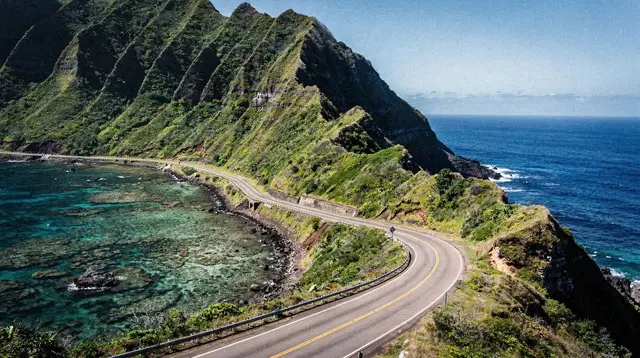
A few days later I made it to the windward side, out past the Nuuanu Pali to Kailua and Kaneohe. The contrast isn’t subtle. The clouds sit differently against the Koolau ridge, the pace on the street is unhurried in a way that has nothing to do with tourism, and the businesses serve people who live there year-round, not people staying for a week. I’m not going to relitigate who should or shouldn’t visit Lanikai’s beach — that argument belongs in its own conversation about the neighborhood’s parking and capacity, not here. What struck me wasn’t the beach itself. It was how ordinary and unperformed everything around it felt, ten minutes from a coastline that postcards had already taught me to expect.
What’s actually past the room
The sights that brought most people to Oahu in the first place aren’t in Waikiki anyway. Pearl Harbor sits on the west side of the harbor, a world away from the beach towels, and the USS Arizona Memorial is the kind of morning that reframes the rest of a trip — I wrote separately about what it’s actually like to visit, and it has almost nothing in common with a Waikiki afternoon. A guided USS Arizona Memorial and Honolulu city tour from Waikiki handles the transfer and pairs the memorial with a look at downtown Honolulu, which most beach-only visitors never see either: the Iolani Palace, Chinatown, the Bishop Museum, none of it more than a few miles from Kalakaua Avenue and none of it drawing the crowds the beach does. A Chinatown food walk or an afternoon among the museums and palaces shows a Honolulu that has nothing to do with resort life.
Diamond Head is closer, technically inside walking range of Waikiki, and yet plenty of week-long guests never make the hike to its rim. Further out, Kualoa Ranch and the whole North Shore run on an entirely different rhythm — surf towns, shrimp trucks, a plantation, not a resort tower in sight. A North Shore day tour covers that entire coast without asking you to drive it yourself, which is the same trade-off as the circle-island tour I mentioned above: less independence, a lot more island for one day.
Why the strip holds people
None of this requires blaming visitors. Waikiki is built, almost architecturally, to keep you inside it. The hotel is there, the beach is there, the tour desk is there, and the marginal effort of leaving — figuring out a bus route, paying for parking, choosing a destination without a brochure to hand you one — is real, even when it’s small. A week is short, jet lag eats a day, and a beach chair is an easy decision when you’re tired. I get it. I made the same decision for three straight mornings.
What I’d push back on is the idea that this is simply what an Oahu trip is. Waikiki is a legitimate place to sleep and a fine beach to swim at, but treating it as a scale model of the island flattens a place that is genuinely varied: a dry western coast, a wet green windward side, a surf-town north shore, a capital with its own neighborhoods that have nothing to do with tourism at all. Never leaving Waikiki isn’t wrong, exactly. It’s just a much smaller trip than the one advertised.
It’s not even hard to leave
This is the part that actually bothers me, because the excuse of difficulty doesn’t hold up. TheBus runs to the windward coast and to the North Shore for a few dollars a ride, and the Skyline rail already reaches toward Pearl Harbor from the west side, with more of the line still to open. I found TheBus more revealing than I expected — not because it’s fast, it isn’t, but because of who else is riding it and what that tells you about the island you’re actually standing on. None of this requires a rental car, a tour guide, or much more than an afternoon and a willingness to sit on a slow bus for a while. If you’d rather have someone else handle the route on your first trip past the strip, a guided Oahu circle island tour from Waikiki covers a lot of that same ground in a single day.
If there’s a single habit I’d recommend changing, it isn’t which beach to add to a list — that’s a job for the guides and itineraries elsewhere on this site, and they do it properly, with hours and prices and routes. It’s simpler than that: leave the perimeter on purpose, at least once, without a fixed plan. Ride TheBus somewhere that isn’t in the brochure. Eat where the parking lot is full of local plates, not rental cars. Notice the windward coast looks and feels like a different island, because in every way that matters to daily life, it is.
I still liked Waikiki. I’d stay there again, for the convenience if nothing else, and comparing it honestly against a base like Ko Olina is worth doing before you book. But I no longer think of those three kilometers as Oahu. They’re a comfortable entry point to it, and the island on the other side of that ridge is where I actually understood what “aloha” gets used to mean, which is its own subject and one I’d rather point you toward than shortcut here. The strip will still be there when you get back. Leave it first.
Evenings don’t have to stay on the strip either
Even the part of the day that seems locked to Waikiki — dinner, a show, something for the evening — has options that pull you a little further from the hotel lobby. Waikiki has no shortage of luau dinner shows, and if you’re going to one, it’s worth reading what to actually expect first so it doesn’t feel like dinner theater built purely for a captive audience. Among the options right on the strip, the Queen’s Waikiki Luau is one I’d point to if you’d rather not travel for the evening; the wider list of best luaus on Oahu covers the ones further afield too, for anyone willing to make an evening of the drive.
For something quieter and closer to sunset than a full show, walking or riding out toward Ala Moana and Magic Island is an easy way to see the city from outside the hotel wall without committing a whole day to it. A sunset Segway tour to Magic Island covers that stretch in about the time it would take to finish a slow dinner, and the view back toward Waikiki from the water is a genuinely different angle on the place than anything you get standing on the sand.
Common questions about seeing Oahu beyond Waikiki
Is Waikiki all there is to see on Oahu?
No. Waikiki is a 3-kilometer stretch of hotels and beach that most visitors never leave, but it is one small district on an island of about 1,545 square kilometers with distinct coasts, towns, and ways of life. TheBus and the Skyline rail make it easy and cheap to see more of it.
Why do so many visitors stay only in Waikiki?
The hotels, the beach, the restaurants, and most tour pickups are all within walking distance, so leaving takes a deliberate decision rather than a default. Resort parking is expensive, which also discourages spontaneous driving.
Can I see the rest of Oahu without renting a car?
Yes for a lot of it. TheBus reaches the windward coast and the North Shore, and the Skyline rail already connects the west side toward Pearl Harbor. It’s slower than driving, but it works.
Is Kaimuki worth a visit?
It’s a small residential neighborhood a short ride from Waikiki with local restaurants and shops that aren’t built around tour buses. It’s less a checklist stop than a change of pace.
Is the windward coast very different from Waikiki?
Yes. Towns like Kailua and Kaneohe are quieter, greener, and rainier, with far fewer hotels and a slower daily rhythm that has little to do with the Waikiki strip.
Does leaving Waikiki mean skipping the famous sights?
No, most of Oahu’s best-known sights, from Pearl Harbor to the North Shore, are outside Waikiki anyway. Leaving the district is often what it takes to reach them.
tours.Opinion
Verified deep-linked GetYourGuide tours. Book through these links and we earn a small commission at no cost to you.
GetYourGuide does not provide a product photo for this activity — the image shows the meeting point, photographed by us.