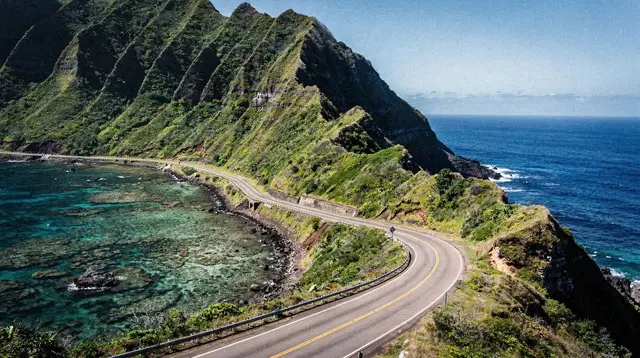
What the Windward Coast is
The Windward Coast is the east side of Oahu, the stretch of shoreline facing the trade winds on the far side of the Koolau mountains from Honolulu. It runs roughly from Kaneohe Bay in the north down through Kailua and Lanikai, backed the whole way by the sheer green face of the Koolau range. The name comes from geography, not marketing: this is the coast the wind hits first, which is exactly why the water stays clear, the air stays cooler than Waikiki, and the hillsides stay a deep, almost implausible green.
This is not a resort strip. There is no cluster of towers, no beachfront hotel district, and no equivalent of Kalakaua Avenue. Kailua and Kaneohe are residential towns first, with a small commercial core, and most people experience the Windward Coast as a day out from Honolulu rather than a place to sleep. That distinction matters for planning: come here for the beach, the kayaking, and the drive itself, then head back over the mountains for dinner and a bed.
Getting there from Waikiki and Honolulu
Two routes cross the Koolau range to reach the windward side, both cutting through the mountains rather than around them.
- Pali Highway (Route 61), through the Nuuanu Pali tunnels, is the more direct route and the one most rental-car GPS apps default to.
- Likelike Highway (Route 63) runs a little farther north, toward Kaneohe, and is the natural choice if Kaneohe Bay is the first stop.
Both are about 30 to 45 minutes from Waikiki in ordinary traffic, longer during the morning and evening commute, since windward residents drive into Honolulu for work and the flow reverses in the evening. A stop at the Nuuanu Pali Lookout on the way over costs nothing but a parking fee (around 7 USD for a non-resident vehicle) and gives a genuinely dramatic first view down onto Kaneohe Bay and the windward towns below — worth the ten-minute detour before descending.
TheBus also reaches Kailua and Kaneohe from Honolulu, but the ride is long and involves a transfer; it is workable for a resident’s errand, not for a visitor on a tight schedule. For most visitors, this coast means a rental car, a rideshare, or a booked tour.
Kailua and Lanikai beaches
Kailua Beach and neighboring Lanikai Beach are the reason most visitors make the trip over the Pali at all. Both are sheltered by an offshore reef and by the small Mokulua islets sitting just off the coast, which cut down the swell and keep the water calm most of the year. The sand is fine and pale, the water runs through shades of turquoise that genuinely photograph the way they look in person, and neither beach carries much of a current on an ordinary day. It is a fair description to call these among the more beautiful calm-water beaches on Oahu, and they are regularly ranked among the best beaches anywhere for exactly that combination of sand, color, and shelter.
Kailua Beach Park has real infrastructure: a large parking lot, restrooms, showers, and lifeguards, plus room to launch a kayak or paddleboard. It is the practical choice for a family with gear.
Lanikai Beach, a short distance south, is narrower, quieter, and has essentially no facilities. There is no public parking lot for Lanikai: visitors park on the shoulder of the residential streets behind the beach, and the neighborhood has tightened restrictions over the years in response to the volume of beach traffic. Commercial kayak operators are directed to launch from Kailua Beach Park, not Lanikai, and rental companies are not permitted to deliver equipment onto the Lanikai sand. Plan to park at Kailua and walk the fifteen minutes down to Lanikai if the neighborhood streets are full, rather than circling for a spot that may not exist.
| Beach | Facilities | Parking | Best for |
|---|---|---|---|
| Kailua Beach Park | Restrooms, showers, lifeguards | Public lot | Families, kayak/paddleboard launch |
| Lanikai Beach | None | Street only, no public lot | Quiet swimming, photos, short walk from Kailua |
Kaneohe Bay and the Koolau cliffs
North of Kailua, Kaneohe Bay is the largest bay in Hawaii, walled in on its landward side by the Koolau cliffs rising almost straight up from sea level. The bay is shallow and reef-protected, which is what makes the offshore sandbar tours possible: boats anchor over a natural sandbank far from land where the water is barely waist-deep, a genuinely odd and popular half-day excursion. The bay is also the base for several of the guided kayak and snorkel trips that head out toward the Mokulua islets from the Kailua side.
Inland from the bay, the base of the Koolau cliffs is where Kualoa Ranch sits, along with smaller stops like the Byodo-In Temple. Both are close enough to combine with a windward beach day, though each deserves its own planning rather than being squeezed in as an afterthought. The ranch is a working cattle property that has doubled as a film set for decades, and the full Kualoa Ranch guide covers the activity options, from an ATV ride through the valley to a more relaxed tour; the movie sites tour of Kualoa is the pick for anyone chasing the film-location angle specifically, and the guide to Kualoa with kids covers which of the ranch’s activities suit younger visitors. Out on the water, the shallow sandbar in the middle of the bay is its own half-day outing, detailed in the Kaneohe sandbar tours guide.
Trade winds and weather
The windward name is literal: this coast catches the northeast trade winds more directly than Honolulu does, and it sits on the wetter, greener side of the island as a result. Expect more cloud and a better chance of a passing shower here than in Waikiki on any given day, especially toward the mountains, and expect the air to feel a few degrees cooler thanks to the wind. None of this makes the coast a wet-season write-off — showers here are typically brief, mornings tend to be clearer than afternoons, and the wind that brings the occasional cloud is the same wind that keeps the heat from ever feeling oppressive.
It is a genuine trade-off against Waikiki’s more reliably sunny microclimate, not a reason to avoid the coast. For a wider view of how the seasons play out across the island, see the guide to the best time to visit Oahu; winter visitors watching for marine life should also check the humpback whale season guide, since the whales that pass Oahu in winter are visible from windward viewpoints as well as from Waikiki. The Pacific hurricane season, covered in the Oahu hurricane season guide, runs alongside the wetter months and is worth a glance for anyone traveling between June and November.
Where to stay: Honolulu or Waikiki, not here
The Windward Coast has very little hotel capacity compared with Waikiki or Ko Olina. Kailua has a scattering of vacation rentals and a few small inns, but nothing resembling a resort strip, and Kaneohe has essentially none aimed at visitors. For most trips, the practical plan is to base in Waikiki or elsewhere in Honolulu, where the hotel selection, restaurants, and nightlife are, and treat the Windward Coast as a half-day or full-day excursion reached by car.
Anyone drawn specifically to the quiet, residential character of Kailua and willing to manage without a resort’s amenities can find a vacation rental there, but it is a deliberate choice, not the default. The broader where to stay on Oahu guide walks through the trade-offs between the main bases in more detail, and the resort fees and hidden costs guide is worth reading before booking anywhere on the island, since it affects the total price regardless of which coast a visitor sleeps on.
Who this coast is for
The Windward Coast suits a specific kind of traveler more than it suits everyone. It rewards people who want calm water over waves, quiet residential streets over a boardwalk, and a morning of kayaking to a pair of offshore islets over a lesson in Waikiki’s beginner surf. Families with young children often prefer Kailua Beach Park’s sheltered water and real facilities to the open ocean elsewhere on the island. Anyone who has already spent a day or two in Waikiki and wants a genuinely different mood — greener, wetter, slower — will find it here within 45 minutes.
It suits this profile less well if the goal is beachfront convenience: there is no walking from a hotel room to the sand here the way there is in Waikiki, and evenings on the Windward Coast are quiet by design. Treat it as a day trip layered onto a Honolulu or Waikiki base, covered in more detail in the one-day Windward Coast itinerary and the broader guide to Oahu overall.
Some visitors see this coast only in passing, as one stop on a longer loop rather than a dedicated day. The circle island tour guide explains how Kailua and Kaneohe fit into that itinerary alongside the North Shore, and families weighing where to swim will find Kailua Beach Park compared against the island’s other calm-water options in the family-friendly beaches guide.
Not the North Shore
It is worth being precise about one thing: the Windward Coast and the North Shore are frequently lumped together as Oahu’s “wild coast,” and they are not the same place. The Windward Coast runs along the east side of the island, backed by the Koolau cliffs, calm and reef-protected for most of the year, and centered on Kailua and Kaneohe. The North Shore is on the north side, centered on Haleiwa, and known for big winter surf that makes several of its beaches genuinely dangerous to swim in December and January. The drive between them takes close to an hour, the geography looks nothing alike — cliffs and a sheltered bay here, open beach and reef breaks there — and the two should never be folded into one vague description of a rugged coastline. A trip planned around one does not automatically cover the other.
Kayaking to the Mokulua islets
The single most distinctive activity on this coast is paddling out to the Mokulua islets, the pair of small, uninhabited islands sitting just offshore from Lanikai. Guided and self-guided options both exist, from a fully outfitted guided kayak and snorkel tour to the Mokulua Islands with an instructor and gear included, to a self-guided rental for paddlers comfortable managing the crossing themselves.
For a different pace, an e-bike and kayak combination pairs a ride along Kailua’s flat streets with the paddle out to the islets, and a half-day tour covering both the Windward Coast and the Koolau foothills works well for visitors who want the scenery without renting their own gear. None of these trips require prior kayaking experience, but all depend on ordinary trade-wind conditions; operators call off crossings when the wind or swell picks up, so build in a flexible day rather than a fixed departure time if the Mokulua paddle is the priority.
a guided kayak and snorkel trip out to the Mokulua islets is the most complete way to see this stretch of coast from the water, gear and instruction included. For paddlers who’d rather set their own pace, a self-guided kayak rental out to the islets or a self-guided paddle to Popoia Island in Kailua Bay covers the same water without a group schedule. Travelers wanting the wider view of the windward side and the Koolau foothills together can combine the coast and the mountains on a half-day tour linking the coastline to the lush Koolau range, and for a different pace entirely, a guided e-bike and food tour around Kailua covers the town itself between beach stops.
Hiking above the coast
The ridge above Lanikai offers the coast’s best-known hike: a set of old military pillboxes reached by a short, steep climb, with a view down over Kailua, Lanikai, and the Mokulua islets that is one of the better sunrise spots on Oahu. It is covered in full in the Lanikai Pillbox hike guide, including timing and what to expect underfoot. It is one entry in a wider set of trails covered in the best hikes on Oahu guide, and anyone new to hiking on the island should read the hiking safety and permits guide first — trail conditions and closures on Oahu change with weather and erosion more often than visitors expect.
Getting around once you’re here
Kailua’s commercial strip, the beach parks, and the trailheads are spread out enough that walking between all of them in one visit is impractical without a car or bike. The getting around Oahu guide lays out the island-wide options, and the rental car and parking guide covers what to expect for parking near the beach parks specifically. Visitors relying on TheBus rather than a rental car should read the TheBus and Skyline guide before planning a windward day, since the route from Honolulu involves a transfer; the tours versus rental car guide is a useful comparison for anyone deciding between driving themselves and booking a guided trip out to this side of the island.
A note on Lanikai’s neighborhood
Lanikai’s popularity has outpaced its infrastructure, and the resulting friction with residents is real, not a rumor: the parking restrictions described above exist because of it. The overtourism in Lanikai piece goes into the background, and it is worth reading before treating the neighborhood’s streets as a free parking lot. It also pairs with a broader point covered in Waikiki is not the whole island: the Windward Coast is one of the clearest examples of how different Oahu looks once a visitor leaves the resort corridor. Anyone swimming or snorkeling here should also know that Hawaii banned the sale of sunscreens containing oxybenzone or octinoxate in 2021 to protect reef life, a point covered in the sunscreen ban and reef safety guide.
Windward Coast: frequently asked questions
How long does it take to get to Kailua from Waikiki?
Around 30 to 45 minutes by car over the Nuuanu Pali or via the Likelike Highway, depending on traffic. Rush-hour commute traffic in both directions can add significant time, since windward residents commute into Honolulu.
Is Lanikai Beach hard to park at?
Yes. There is no public parking lot for Lanikai; visitors park on residential streets behind the beach, and space is often limited. Kailua Beach Park, a short walk away, has a proper public lot and is the more reliable option.
Can I book a kayak tour that launches directly from Lanikai?
No. Commercial kayak operators are directed to launch from Kailua Beach Park rather than Lanikai, and rentals are not delivered onto the Lanikai sand. Any Mokulua kayak trip will start from Kailua.
Should I stay overnight on the Windward Coast?
Most visitors don’t. Hotel capacity here is minimal compared with Waikiki or Ko Olina, so the coast is typically visited as a half-day or full-day trip from a Honolulu or Waikiki base rather than used as a base itself.
Is the Windward Coast the same as the North Shore?
No. They’re on opposite sides of the island, with different geography — sheltered bay and cliffs on the Windward Coast, open beach and winter surf breaks on the North Shore — and they should not be described with the same “wild coast” label.
Does it rain more on the Windward Coast than in Waikiki?
Generally yes. The trade winds hit this side of the island more directly, bringing more cloud and a better chance of a brief shower, especially near the mountains. Showers here tend to be short rather than day-ruining.
What’s the best activity if I only have half a day here?
A guided or self-guided kayak trip to the Mokulua islets from Kailua Beach Park is the single most distinctive windward activity, combining the beach, the calm water, and the view of the islets in one outing.
Do I need a rental car to visit the Windward Coast?
A car or rideshare is the practical option. TheBus does reach Kailua and Kaneohe from Honolulu, but the trip involves a transfer and takes considerably longer than driving.