A different Oahu, about an hour from Waikiki
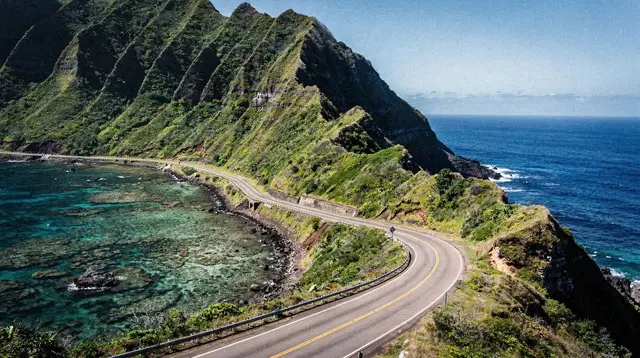
The North Shore is the stretch of coast running roughly from Haleiwa to Kahuku on the northwest side of Oahu, and it feels like a different island from Waikiki or the high-rises of Honolulu. There is no skyline here, no resort towers, and no bus route that gets you there in a reasonable amount of time. What there is: small plantation-era buildings, shave ice stands, shrimp trucks parked on the roadside, and a run of beaches that produce some of the most-photographed waves on Earth every winter.
Driving time from Waikiki is usually quoted as around 45 minutes, and that number is honest only in light traffic, typically outside the morning and evening rush. In practice, allow 1 hour to 1.5 hours each way, longer on weekends when everyone else has the same idea, and longer still if a stop at Haleiwa town coincides with lunch. Google Maps or Waze at the time of travel is a better source than any fixed number printed on a page, because the H-1 and H-2 corridors that feed the North Shore back up unpredictably. Build the drive into the day rather than treating it as a formality.
The region overlaps in most visitors’ minds with the windward coast to the east — both are green, rural, and a world away from Waikiki — but they are separate coasts with separate roads. The North Shore faces north and west into the open Pacific, which is exactly why it gets the winter swells that the windward coast, more sheltered, does not see in the same way.
Winter waves, summer calm: the single fact that matters most
The North Shore’s defining trait is not its beaches on their own — it’s what the ocean does to them by season, and the difference is not subtle.
From roughly November through March, and most dramatically from December through February, long-period swells generated by storms far out in the North Pacific arrive here and break as waves that regularly reach 3 to 6 meters (10-20 feet), with bigger days well beyond that at spots like Waimea Bay and the Banzai Pipeline. This is when the professional surf contests happen, when the sand at Sunset Beach and Pipeline gets stripped away by the surf and the shoreline itself changes shape week to week. It is a genuine spectacle to watch from the beach or the road. It is not a swimming season. Rip currents are severe, shore breaks close out hard, and the same waves that make the North Shore famous have killed and injured both surfers and spectators who underestimated them. Lifeguards close beaches to swimming on big days; the flags and posted signs are not a formality.
From roughly May through September, the same beaches flip completely. The water goes flat to gently rolling, visibility improves, and Waimea Bay and Sunset Beach turn into some of the calmest, most swimmable water on the island, good for families and casual snorkeling. This seasonal reversal is the single most important thing to understand before planning a North Shore visit: the same spot that is a photogenic death trap in January can be a placid swimming beach in July. Always check conditions for the specific week of a trip rather than assuming either season applies.
| Season | Typical wave height | Good for swimming? | What’s happening |
|---|---|---|---|
| November-March | 3-6 m (10-20 ft), bigger on peak days | No — dangerous even for strong swimmers | Big-wave surf contests, spectator crowds, beach width shrinks |
| May-September | Calm to small | Yes | Best swimming and beginner snorkeling window |
| April, October | Transitional | Check conditions day by day | Shoulder months, less predictable |
Haleiwa: the town that anchors the coast
Haleiwa is the small former plantation town that functions as the North Shore’s hub — a single main strip of surf shops, shave ice counters, art galleries, and a harbor where charter boats depart. It’s the natural stop for lunch, a bathroom break, and a look at the surf shops that supply the pro tour. It is not a resort town; there are few hotels here, and most visitors come for a few hours rather than staying overnight. Traffic through the town center can crawl on weekends, so a weekday visit, or an early start, makes for an easier stop.
North and east of Haleiwa, the coastal highway strings together the beaches that give the region its reputation. Waimea Bay is the most iconic — a deep, round bay that hosts the biggest of the winter swells and, at the same time, is a calm swimming and cliff-jumping spot in summer. Sunset Beach and the Banzai Pipeline sit further along, both legendary among surfers for the shape and power of their winter waves; Pipeline in particular is one of the most consequential waves in the sport, breaking over a shallow reef close to shore. None of these are places to swim in winter, whatever the water looks like from the road.
Further east toward Kahuku, the landscape turns to former sugar and pineapple fields, and roadside shrimp trucks — a North Shore institution — sell garlic shrimp plates to a line of cars and tour buses. Beyond Kahuku, Laie is home to the Polynesian Cultural Center, a Pacific-culture park with an evening luau and show, and one of the few attractions on this coast that runs on a fixed schedule rather than depending on the ocean. Inland from Haleiwa, toward Wahiawa, the Dole Plantation and its pineapple fields are a common stop on the way back toward Honolulu, since the highway that leads there also connects to the H-2 freeway south.
Specific beach-by-beach advice, tide tables, and where to actually park at each spot are covered in the dedicated North Shore day tour guide and the North Shore surf season guide rather than here.
Getting there: plan on a car
There is no practical public transit option to the North Shore. TheBus does technically run routes that reach Haleiwa, but the ride from Waikiki takes multiple hours with a transfer, which makes it unworkable for anyone with a single day to spend. For nearly every visitor, the choice is between a rental car and a guided tour.
A rental car gives full control over the day — stopping where the waves look interesting, lingering over shave ice, adjusting the route on the fly — but it also means finding parking along a coastal highway that gets genuinely congested on weekends and during big swell days, when roadside parking near Pipeline and Sunset Beach fills early. A guided tour removes the parking problem and usually bundles in stops that are harder to plan solo, such as a shrimp truck lunch or a scenic detour, though it runs on a fixed schedule.
Either way, the North Shore pairs naturally with a broader loop of the island rather than an out-and-back drive. Many visitors combine it with stops on the way there or back — the drive up passes reasonably close to the H-2 corridor, and a full circle island route can add the windward coast on the return leg for a longer but more complete day. For travelers without a car at all, an organized tour is close to the only realistic way to see this coast.
a full-day North Shore trip that bundles transport with stops along the coast covers the logistics for visitors without a rental car, and works as a complete day out rather than a shuttle-only ride. For a shorter version, a half-day scenic tour of the North Shore fits into a schedule that also has plans back in Waikiki or Honolulu that same evening.
What to actually do here
Watching the waves is free and, in winter, arguably the main event — pulling off at a scenic lookout above Waimea Bay or Pipeline on a big day is a legitimate way to spend an hour, no booking required. Beyond spectating, the North Shore supports a short list of activities that make sense on this particular coast:
Surfing is the obvious one, and it runs in both directions by season. In summer, the same gentle breaks that make Waimea Bay swimmable also make it a workable beginner surf spot, with lesson operators based along the coast. In winter, surfing here shifts to experienced-only, and watching from the sand becomes the visitor’s role rather than paddling out. a North Shore surf lesson is worth booking specifically for the summer season; a winter booking for the same activity should be treated with more scrutiny about which beach and which week it actually runs.
Shark encounters operate out of Haleiwa harbor rather than the beaches themselves — boats head a few miles offshore into open water where wild sharks, mostly Galapagos and sandbar sharks, are viewed from a submerged cage or, on some operators’ trips, cage-free in open water. This runs close to year-round, less weather-dependent than the surf. a North Shore shark cage diving trip is the more cautious version of this for anyone new to the idea; more experienced or adventurous visitors sometimes choose the open-water alternative instead.
Sunset cruises run from Haleiwa harbor in summer, when the water off the coast is calm enough for a comfortable sail — a different vantage point on the same coastline that draws surfers, watched from a boat rather than the sand. a sunset cruise departing from Haleiwa harbor only operates in the calmer months and should not be booked expecting it to run through a winter swell.
Food is its own reason to come: shrimp trucks around Kahuku, shave ice in Haleiwa, and roadside fruit stands are as much a part of the North Shore day as any single beach. These specific spots are covered in more detail in the shrimp truck guide.
Who this coast suits, and who it doesn’t
The North Shore rewards visitors who want to see a working, rural side of Oahu and who are drawn to the ocean’s power rather than just a beach to lie on. Surf fans, photographers, and anyone curious about the culture behind competitive big-wave surfing will find a full day’s worth of interest here, in any season. It also suits families and swimmers specifically in the May-to-September window, when the same beaches that host winter surf contests become some of the calmest water on Oahu.
It suits fewer people if the goal is a straightforward beach day with guaranteed swimming, planned for a fixed date without checking conditions first, or a trip without a car or tour booked — the lack of transit makes a spontaneous visit difficult. And it is the wrong plan entirely for anyone hoping to swim here on a winter visit; that expectation, more than any other, is what gets visitors into trouble on this coast. If a beach day with reliable, calm water is the priority regardless of season, the sheltered lagoons at Ko Olina or the protected reef at Waikiki are safer bets year-round.
For a broader loop that includes this coast alongside the rest of the island, see the circle island tour guide and the one-day North Shore itinerary. Travelers building a longer trip can also see how this region fits into a multi-day plan in Oahu highlights over two days or the five-day complete Oahu itinerary.
North Shore Oahu: frequently asked questions
How long does it take to drive from Waikiki to the North Shore?
Around 45 minutes in light traffic, but realistically 1 to 1.5 hours each way once normal traffic on the H-1 and H-2 is factored in. Weekends and rush hours push it toward the longer end, so treat the shorter figure as a best case rather than a planning number.
Is it safe to swim at Pipeline or Sunset Beach?
Only in summer, roughly May through September, when the water is calm. From November through March, these same beaches carry powerful winter surf, strong currents, and real drowning risk even for confident swimmers — they are for watching, not swimming, in that window.
Can I get to the North Shore without a car?
Not practically. TheBus technically reaches Haleiwa but the ride takes several hours with a transfer, so almost every visitor either rents a car or books a guided tour to cover this coast.
What is Haleiwa?
Haleiwa is the small town that anchors the North Shore, with surf shops, shave ice stands, art galleries, and a harbor used by charter boats. It’s the natural lunch and rest stop for anyone touring this coast.
When is the best time to visit the North Shore?
May through September for swimming and calm water; November through March for watching the winter surf spectacle at its biggest, without going in the water. Both are legitimate reasons to visit, but they call for different expectations.
Are the shrimp trucks near Haleiwa or further along the coast?
Most of the well-known shrimp trucks cluster around Kahuku, east of Haleiwa toward Laie, rather than in Haleiwa town itself. Details on specific trucks are in the dedicated shrimp truck guide.
Can I combine the North Shore with Pearl Harbor or Waikiki in one day?
The North Shore alone is a comfortable half-day to full-day trip once driving time is included; combining it with Pearl Harbor in the same day is a long stretch and not usually recommended. Pairing it with a broader circle-island route that includes the windward coast is more realistic.
Is the Polynesian Cultural Center part of the North Shore?
Yes — it’s in Laie, at the northeastern end of this coast, and is one of the few North Shore attractions that runs on a fixed schedule rather than depending on the ocean or season.