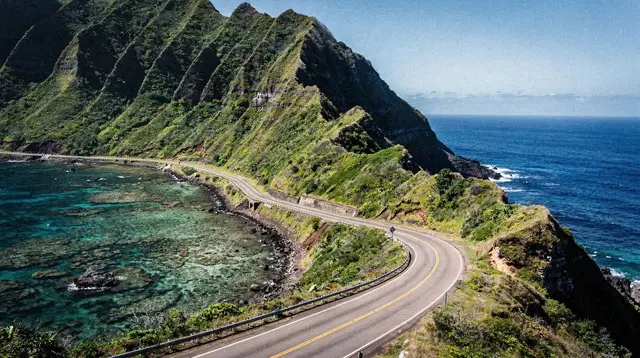
What Ko Olina actually is
Ko Olina is a master-planned resort district on Oahu’s leeward, or western, coast, built around four man-made lagoons cut into what was once a stretch of rocky, exposed shoreline. Each lagoon is a few hundred meters across, protected by a rock breakwater that keeps ocean swell and most currents out. The result is calm, shallow water that stays swimmable in conditions that would send you looking for a lifeguard-flagged beach elsewhere on the island. That single feature — four sheltered lagoons within walking distance of a cluster of large hotels — is the whole reason Ko Olina exists as a destination rather than a neighborhood pass-through on the way to Waianae.
The lagoons are open to the public, not just resort guests, though public parking is limited and fills early, especially on weekends. Guests staying at the resorts on-site use dedicated hotel access instead. If you’re not staying here, plan to arrive before mid-morning or accept that you may not find a spot.
This is a different kind of stop from most of what fills a things to do in Oahu list. There’s no historic site, no hike, no surf break to watch. Ko Olina is infrastructure — a resort zone with a golf course, a marina, and a short paved coastal path connecting the lagoons — and it earns its place on an itinerary by being useful, not by being remarkable to look at.
Where it sits, and why the distance matters
Ko Olina is in Kapolei, on Oahu’s leeward coast, roughly 30 kilometers (about 19 miles) west of central Honolulu. The drive from Waikiki typically runs 40 to 50 minutes on the H-1 freeway in light traffic, and it can stretch well past an hour during the island’s real rush-hour congestion, which builds on the H-1 both mornings and evenings. There is no direct bus route that makes this a practical trip without a car, and no ferry service connects any part of Oahu’s coastline — the island has none. TheBus reaches the general area with transfers, but it’s a multi-hour proposition, not a sensible way to get a family and beach gear to a lagoon for the day.
This is the piece of planning that trips people up most often: Ko Olina looks close to Honolulu on a map of Oahu, because Oahu itself is only about 1,545 square kilometers. In practice, it’s far enough that a car — either a rental or an organized transfer — is close to mandatory. A taxi or rideshare from Waikiki is workable for one trip but expensive to repeat daily; a rental car is the more sensible choice for anyone spending more than a night out here.
The practical upshot: don’t plan Ko Olina as a spontaneous half-day add-on to a Waikiki-based trip unless you’re comfortable with roughly 90 minutes of driving round-trip, plus parking. It works far better as either its own base for part of your stay, or as a stop paired with something else out west, most obviously Pearl Harbor, which sits on the same H-1 corridor about 20-30 minutes closer to town.
A drier, sunnier coast
Ko Olina sits in the rain shadow of the Waianae Range, Oahu’s western mountains, whose highest point, Mount Kaala, tops out at 1,227 meters. Moisture-laden trade winds drop most of their rain on the windward side and the mountains before reaching the leeward coast, so Kapolei and Ko Olina run noticeably drier and sunnier than Waikiki or the windward coast through most of the year. Oahu’s two seasons — a dry stretch from May to October and a wetter one from November to April — still apply here, but the wet season shows up as fewer, lighter days rather than the regular afternoon showers that hit windward valleys. Daytime temperatures run close to what you’d see in Honolulu, generally 26-27°C (79-81°F) in winter and 29-31°C (84-88°F) in summer, with the added benefit of more consistent sun.
That reliability is part of the resort pitch: a week of pool and lagoon time with a lower chance of a rained-out afternoon than you’d risk on the windward side.
Who Ko Olina fits, and who it doesn’t
Good fit:
- Families with toddlers or young children who need water with no real wave action and clearly bounded swimming areas
- Travelers who’ve booked a resort package and want the beach, pool, and dining largely handled on-site
- Couples or groups who’d rather spend evenings away from Waikiki’s density and traffic
- Anyone doing a longer Oahu trip who wants two bases — a few nights near the water on the west side and a few in town
Poor fit:
- Visitors without a rental car who plan to explore beyond the resort itself
- Anyone whose priority is walkable access to Honolulu’s museums, Chinatown, or Waikiki’s beach and nightlife
- Surfers or snorkelers chasing reef life and real swell — the lagoons are calm by design, which means comparatively little marine life to see
- Short trips of three or four days total, where the drive time eats into time better spent elsewhere
If your trip is under a week and centers on Pearl Harbor, Diamond Head, and Waikiki’s beach, Ko Olina as a second base adds a lot of driving for what may not be worth the trade-off. It earns its place on longer trips, or on trips built specifically around a family-resort stay.
Ko Olina versus Waikiki as a base
| Ko Olina | Waikiki | |
|---|---|---|
| Water | Calm, shallow, wave-free lagoons | Open ocean beach, gentle to moderate surf |
| Getting around | Car needed for almost everything | Walkable; TheBus and Biki cover the rest |
| Distance to Pearl Harbor | About 20-30 minutes | About 30-40 minutes |
| Distance to Honolulu sights | 40-50 minutes | Minutes to central Honolulu |
| Atmosphere | Quiet, resort-contained | Dense, urban, beach-town energy |
| Best for | Families, resort-focused stays | First-time visitors, no-car trips |
For a closer look at that trade-off, see Waikiki vs Ko Olina and, for the general question of whether you need wheels at all, tours vs rental car on Oahu.
What’s actually here
Beyond the four lagoons, Ko Olina centers on a small handful of large hotels and resorts, a marina used by snorkel and sunset-sail boats, and an 18-hole golf course. There’s no equivalent to Waikiki’s dense strip of shops and restaurants — dining options are mostly resort-based, plus a modest lineup of restaurants clustered near the marina.
The marina is also the departure point for several boat trips that leave straight from Ko Olina rather than Honolulu, which is one of the district’s real advantages if you’re staying nearby: no drive to a harbor across town. A sunset sail with a luau-style dinner is one of the more popular options — the Ko Olina sunset sail and luau experience combines an evening on the water with dinner and entertainment without requiring a separate trip into town.
For daytime water time, a catamaran that pairs snorkeling with a luau lunch, like the Ko Olina catamaran snorkel sail with luau, works well for groups who want more than lagoon time but aren’t up for a full-day excursion. There’s also a boat trip built specifically around looking for dolphins along this stretch of coast, the snorkel sail that watches for dolphins off Ko Olina — worth noting that no operator can guarantee a sighting, and wild dolphins should always be given space rather than chased or swum after.
Just up the road, the Wai Kai lagoon complex adds a different kind of water activity: a man-made wave pool used for surfing and bodyboarding sessions at different size levels, plus general lagoon access. The Wai Kai Ultimate Pass covers a day of lagoon access along with other on-site activities, useful for a family looking to fill a full day without leaving the area.
Further down the coast toward Waianae, a few operators run boat trips out of smaller harbors, including options built around swimming with wild spinner dolphins, such as the Waianae swim-with-dolphins trip on a small power boat. These require driving further west past Ko Olina itself, into territory covered on the southeast shore page’s counterpart — the quieter, drier stretch toward Makaha and Yokohama Bay.
Planning a stay here
A realistic day at Ko Olina without a boat trip costs relatively little beyond your resort rate and food — the lagoons themselves are free to enter. Add a boat excursion, a rental car, and resort dining, and a reasonable daily budget for two adults runs somewhere in the 150-400 USD range depending on the resort tier and how many paid activities you add, before taxes. Remember that Hawaii hotel stays carry roughly 18-19% in combined taxes on top of the room rate, plus a nightly resort fee that’s charged separately and almost never included in the advertised price — see resort fees and hidden costs before you book.
If you’re combining Ko Olina with the rest of Oahu, the most efficient pairing is a westbound day that starts at Pearl Harbor — remembering that the USS Arizona Memorial requires a reservation made up to eight weeks ahead — and continues to Ko Olina for the afternoon. Trying to squeeze in honolulu sightseeing on the same day usually means too much driving; better to treat Ko Olina and central Honolulu as separate legs of the trip.
For a longer stay built around this side of the island, see how many days on Oahu and where to stay on Oahu for how a Ko Olina base fits into a full itinerary, and getting around Oahu for the practicalities of the drive itself, since neither Skyline nor TheBus currently offer a realistic direct route out here.
Ko Olina, Oahu: frequently asked questions
How far is Ko Olina from Honolulu Airport?
Roughly 30-40 minutes by car in light traffic, longer during peak periods on the H-1. It’s actually somewhat closer to the airport than Waikiki is in driving time, though Waikiki has more transport options for the trip.
Can I visit Ko Olina without staying at a resort there?
Yes. The lagoons are public, but parking is limited and fills quickly, particularly on weekends and holidays. Arriving before mid-morning improves your odds significantly.
Do I need a rental car to stay at Ko Olina?
For anything beyond the resort grounds and lagoons, yes. There’s no practical bus or ferry connection to Waikiki or central Honolulu, and rideshare fares add up quickly if you’re making the 40-50 minute trip more than once.
Is Ko Olina good for young children?
It’s one of the better options on Oahu for that specifically. The lagoons are shallow, calm, and enclosed, without the wave action or currents you’d find at most open beaches on the island.
Is Ko Olina closer to Pearl Harbor than Waikiki is?
Yes, by about 10-15 minutes. If Pearl Harbor is a priority, staying near Ko Olina or Kapolei shortens that particular drive, even though it lengthens most others.
What’s the weather difference between Ko Olina and Waikiki?
Ko Olina sits in the rain shadow of the Waianae Range, so it sees less rain and more consistent sun than Waikiki, especially during the November-to-April wet season. Temperatures are similar; the difference is mainly in rainfall and cloud cover.
Are there restaurants and shops within walking distance at Ko Olina?
Limited compared to Waikiki. Dining is mostly resort-based, with a small cluster of additional restaurants near the marina. It’s not a walkable town in the way Waikiki or Kailua are.
Should I split my Oahu trip between Waikiki and Ko Olina?
For trips of five days or longer, it can work well — a few nights of urban access followed by a few nights of resort calm. For shorter trips, the drive time between the two usually isn’t worth the split; pick one base and take day trips instead.