Getting from Waikiki to Pearl Harbor
How do I get from Waikiki to Pearl Harbor, and how long does it take?
TheBus (routes 20 and 42) takes 60 to 90 minutes and costs a few dollars; driving takes 25 to 50 minutes depending on traffic, with parking on site; a paid shuttle or rideshare takes 20 to 40 minutes door to door. Because entry time slots are fixed, plan to arrive at the Pearl Harbor Visitor Center at least 30 minutes before your reserved time, which means leaving Waikiki 60 to 120 minutes earlier depending on the option and time of day.
Pearl Harbor runs on fixed entry windows, not walk-up arrivals, so the transport question is really a timing question: how do you get from a Waikiki hotel to the Pearl Harbor Visitor Center reliably enough to be there before your slot closes. This page covers only that — the routes, the realistic travel times, and when to leave. Booking the USS Arizona Memorial reservation itself is covered separately in our ticket guide.
The five ways to get there
There are five practical options between Waikiki and Pearl Harbor: TheBus, the Skyline metro combined with a bus transfer, a paid shuttle booked through a tour operator, rideshare or taxi, and a rental car. Each trades off cost, flexibility and travel time differently.
| Option | Travel time from Waikiki | Approximate cost | Notes |
|---|---|---|---|
| TheBus (route 20 or 42) | 60–90 min | A few dollars, HOLO card | Slow but direct enough, no transfer needed |
| Skyline + bus | 75–100 min | A few dollars, HOLO card | Not faster than TheBus alone for most Waikiki hotels |
| Paid shuttle (tour operator) | 30–45 min | Bundled into tour price | Hotel pickup, fixed departure window |
| Rideshare or taxi | 25–40 min off-peak, 40–60 min rush hour | Fare varies with demand | Fastest door to door outside rush hour |
| Rental car | 25–50 min depending on traffic | Free parking on site | Most flexible, but adds a parking-lot walk |
TheBus: routes 20 and 42
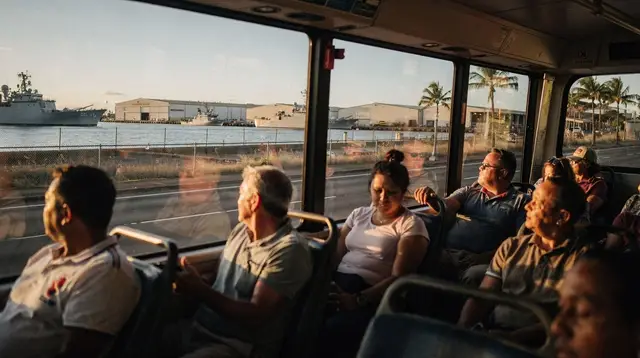
TheBus is the only public transit option that gets you from central Waikiki to Pearl Harbor without a transfer. Two routes serve the area: route 20 (Airport-Waikiki) and route 42 (Ewa Beach-Waikiki). Both stop within a short walk of the Pearl Harbor Visitor Center, on Kalakaua Avenue near Halekauwila. Route 20 also serves the airport corridor, so it can be crowded with luggage in the early morning.
Buses on both routes run roughly every 20 to 30 minutes during the day, tighter around rush hour and wider midday and on weekends — check current frequency and stops on thebus.org before you go, since schedules and fares were revised in 2026. Budget 60 to 90 minutes for the ride itself, plus the walk from the bus stop to the security checkpoint. TheBus is affordable and genuinely usable for this trip, but it is the slowest option on the list and the one most exposed to traffic delays it can’t route around.
Fare is paid in cash without change given, or with a HOLO card, which caps your spending for the day once you’ve paid enough single fares. If you’re combining Pearl Harbor with other stops that day, the HOLO card usually works out cheaper than buying single tickets each time. See our full guide to TheBus and Skyline for fare details and how the card works.
Skyline: useful, but not yet a Waikiki shortcut
The Skyline automated metro opened its first two segments from East Kapolei to the Kalihi Transit Center, with a station named Makalapa (Pearl Harbor) that puts you close to the memorial complex. That makes Skyline a credible way to reach Pearl Harbor from the airport or from the west side of the island. It does not reach Waikiki or downtown Honolulu yet — that extension isn’t expected until the early 2030s — so a Waikiki-based visitor riding Skyline still needs a bus to close the gap at one end or the other. For most Waikiki hotels, combining Skyline with a connecting bus takes about as long as riding TheBus directly, with the added complexity of a transfer, so it rarely saves time on this specific trip. See our transit overview for how Skyline fits into wider island travel.
Paid shuttle through a tour operator
Most organized Pearl Harbor tours from Waikiki include round-trip hotel pickup as part of the price. A shuttle van collects passengers from a handful of central Waikiki hotels on a set schedule, typically 30 to 45 minutes before the tour’s entry slot, and the ride itself runs 30 to 45 minutes depending on how many other hotels are on the route. This is the least effort option: no navigating, no parking, no walking from a bus stop with the sun already up. It costs more than public transit and locks you into the tour’s schedule rather than your own, which matters if you’d rather visit Pearl Harbor independently and choose your own reservation time. Comparing private and small-group tours against a self-guided visit is covered in our Pearl Harbor tours guide.
If your plan is a private or small-group Pearl Harbor tour, pickup logistics are already built in — see the private Pearl Harbor and USS Arizona tour with hotel pickup or the small-group Pearl Harbor WWII history tour for a shared-van option at a lower price point.
Rideshare and taxi
Rideshare apps and taxis are the fastest realistic option outside of driving yourself, and pickup and drop-off at the Pearl Harbor Visitor Center is well organized, with a marked area rather than a scramble at the curb. Off-peak, expect 25 to 40 minutes from a central Waikiki address. During the morning commute on the H-1, that can stretch to 40 to 60 minutes, so don’t assume rideshare beats the traffic that slows everyone else down — it just beats waiting for a bus in that same traffic. Fares fluctuate with demand, more so at peak commute hours and during the first entry slots of the day when many visitors are heading the same direction at once. Booking your return pickup for a set time, rather than requesting on the spot, avoids a wait after you’ve finished at the memorial and are ready to leave.
Driving and parking
A rental car gives the most control over departure time and is the option least affected by anyone else’s schedule. From Waikiki, the drive to Pearl Harbor is mostly via the H-1 freeway westbound, and it runs 25 to 50 minutes depending on when you leave. On a weekday, the 7 to 9 a.m. commute into town runs opposite your direction of travel for the morning slots, so traffic is usually lighter than you’d expect for a rush-hour drive — but an early-slot reservation still means an early departure, and afternoon return trips can catch the outbound commute traffic heading west later in the day.
Parking at the Pearl Harbor National Memorial Visitor Center is free, which is a real point in favor of driving, since Waikiki hotel parking itself typically runs 45 to 75 USD a night. The lot is large but fills up on busy mornings, particularly around the first reservation windows, so arriving with buffer time matters as much for finding a space as for clearing security. Once parked, it’s a short walk to the checkpoint. For a full comparison of when a rental car is worth it on Oahu versus relying on transit and tours, see rental car and parking on Oahu.
Timing it against the entry slot
Every option above only matters relative to one fixed point: your reserved entry time at the Visitor Center. Arrive too late and a timed reservation can be forfeited; arrive with no buffer and a single traffic slowdown or a full parking lot eats your margin. As a rule, plan to be at the Visitor Center itself at least 30 minutes before your slot, which in practice means:
- By rental car or rideshare: leave Waikiki 60 to 75 minutes before your reservation.
- By paid shuttle: the pickup time set by the operator already accounts for this — just be ready when they say.
- By TheBus: leave Waikiki 90 to 120 minutes before your reservation, more if your slot is before 8 a.m. on a weekday.
Security screening also takes time on busy mornings, another reason the buffer matters more than the mode of transport itself.
Bags and what you can bring
Regardless of how you arrive, no bags are allowed past the Pearl Harbor security checkpoint — nothing larger than a small clutch, roughly 4 by 6 by 14 centimeters. This catches out visitors who drive or take a shuttle more than transit riders, since anyone toting a day bag, backpack or diaper bag will need to check it. A paid bag storage facility is available on site, in the range of 7 to 10 USD, and it is consistently the single biggest cause of delay for visitors who didn’t plan for it. If you’re driving, the simplest fix is leaving bags in the car; if you’re arriving by bus, shuttle or rideshare, plan on the storage fee or travel as light as possible.
Which option fits your trip
The right choice usually comes down to who’s traveling and what else is on the schedule that day. Families with young kids often find a paid shuttle or private tour worth the extra cost, since it removes the standing-and-waiting factor of a public bus with strollers and diaper bags in tow — see Pearl Harbor with kids for more on what makes the visit easier with children along. Budget-focused travelers who don’t mind an early start can save real money on TheBus, especially if they’re already planning to rely on transit elsewhere on the island during the trip; Oahu on a budget covers how that adds up.
First-time visitors trying to fit Pearl Harbor alongside other must-sees in the first day or two should check first-time Oahu planning before locking in a transport choice, since the option you pick affects how much else realistically fits into the same morning. And if you’d rather not decide at all, the Pearl Harbor tour with USS Arizona Memorial from Waikiki bundles entry, transport and guiding into a single booking.
Getting back to Waikiki afterward
The return trip deserves its own thought, since a Pearl Harbor visit isn’t on a fixed exit schedule the way entry is. TheBus and Skyline riders can catch the same routes back from the same stops, though weekday afternoon service can run thinner than the morning peak. Rideshare works well in the other direction too, and booking the pickup for a set time — rather than requesting one on the spot as you walk out of the Visitor Center — avoids standing in the sun waiting for a car to arrive during a busy afternoon. Drivers simply retrace the H-1 route east, though that drive can catch the outbound commute traffic building later in the afternoon on a weekday. Shuttle and tour passengers are covered either way, since the return leg is already built into the price.
Combining the trip with the rest of Pearl Harbor
Once you’ve worked out how you’re getting there, the next questions are usually how long to budget on site and whether to also see the USS Missouri and USS Bowfin, both handled outside the free National Park Service memorial. Our guides to half-day versus full-day planning and to the Missouri and Bowfin cover that separately, along with a combined itinerary that pairs Pearl Harbor with a Honolulu afternoon. If you’re weighing whether to add a broader tour that folds in cultural stops elsewhere on the island, the combined Polynesian Cultural Center and Pearl Harbor day tour pairs the two on one bus, removing the transport question for both stops at once.
Frequently asked questions about getting to Pearl Harbor from Waikiki
What is the fastest way from Waikiki to Pearl Harbor?
A rental car or rideshare is fastest outside rush hour, at 25 to 40 minutes. In morning traffic on the H-1, a paid shuttle or rideshare still beats TheBus, but neither beats leaving early.
Which TheBus routes go to Pearl Harbor from Waikiki?
Route 20 (Airport-Waikiki) and route 42 (Ewa Beach-Waikiki) both stop near the Pearl Harbor Visitor Center. Neither is a direct line from central Waikiki, so expect one seat the whole way plus a short walk, not a transfer.
Is there a direct train from Waikiki to Pearl Harbor?
No. The Skyline metro serves the Pearl Harbor area from the west side of Oahu and the airport, but it does not yet reach Waikiki. Riders from Waikiki still need a bus or another mode for at least part of the trip.
How early should I leave Waikiki for a morning Pearl Harbor reservation?
Leave enough time to reach the Visitor Center 30 minutes before your slot. That means roughly 60 to 75 minutes before your reservation by car or rideshare, and 90 to 120 minutes by TheBus, more if your reservation is before 8 a.m. during weekday rush hour.
How much does parking cost at Pearl Harbor?
Parking at the Pearl Harbor National Memorial Visitor Center is free. What costs money is the mandatory bag storage for anyone who arrives with a bag or large item, since bags are not allowed past security.
Can I take a rideshare like Uber or Lyft to Pearl Harbor?
Yes, rideshare pickup and drop-off is well set up at the Visitor Center, and it is one of the more time-efficient options from Waikiki outside of driving yourself. Booking the return trip in advance avoids a wait after your visit.
Do Pearl Harbor tours include transport from Waikiki?
Many small-group and private tours include hotel pickup in Waikiki, which removes the transport question entirely. That convenience is weighed against cost and schedule flexibility in our guide to choosing a Pearl Harbor tour.
Should I book a Pearl Harbor tour just to avoid the transport question?
It’s a reasonable trade if you’d rather not navigate TheBus or driving yourself, since hotel pickup handles the timing automatically. If you want to see Pearl Harbor on your own schedule and possibly extend the day afterward, a rental car or rideshare keeps that flexibility instead.
Does traffic to Pearl Harbor change by day of the week or time of day?
The H-1 westbound is generally lighter for morning arrivals than the opposing rush-hour direction into town, but afternoon return trips can meet outbound commute traffic later in the day. Weekday mornings before the first entry slots also tend to be the busiest time at the Visitor Center itself, both for parking and for security lines.
Pearl Harbor and USS Arizona Memorial tours on GetYourGuide
Verified deep-linked GetYourGuide tours. Book through these links and we earn a small commission at no cost to you.
GetYourGuide does not provide a product photo for this activity — the image shows the meeting point, photographed by us.