Planning your first trip to Oahu: what to know before you go
What's the single most important thing to plan before a first trip to Oahu?
Book your flight and hotel early (4 to 6 months out for winter), then lock in the reservations that sell out on their own schedule: Hanauma Bay, Diamond Head, and popular restaurants. Everything else can be figured out once you land.
Getting your bearings before you plan anything else
Oahu is one island in the state of Hawaii, and Honolulu is both its capital and the name of the city-and-county government that covers the entire island — about 1,545 square kilometers, roughly 1 million residents islandwide, with around 350,000 in the urban core. The island most people picture when they hear “Hawaii volcanoes” is a different island altogether: the Big Island, about 45 minutes away by plane, where Kilauea, Mauna Kea, and the national park actually are. There’s no active volcano, no lava flow, and no black-sand beach to visit on Oahu itself — worth saying plainly, because it’s the most common mix-up first-time planners make.
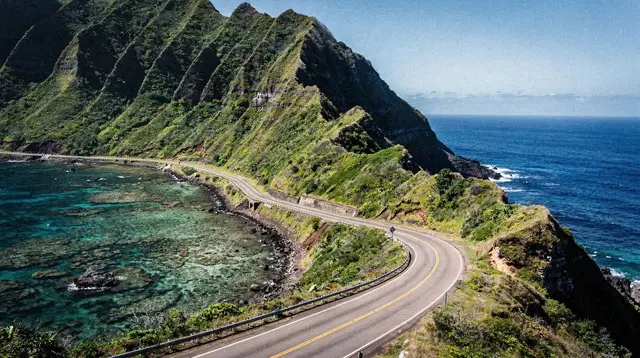
For orientation, the island breaks into a few zones you’ll keep running into as you plan: Waikiki and Honolulu on the south shore, where almost everyone sleeps; Pearl Harbor just west of downtown; the North Shore, the surf coast up top; the Windward Coast, the green, rainier side facing Kailua; and Ko Olina, a resort pocket on the drier west side. This page is meant to give you the shape of the trip — when to book, roughly what it costs, and how the island is laid out — without repeating the deep-dive pages that already cover each of those questions properly. Where a topic has its own guide, we’ll point you there instead of re-explaining it here.
When to book
Flights and hotels are the two things worth locking in earliest, because they’re the two that actually sell out or spike in price — everything else on the island can be arranged once you’ve landed.
- Winter (December through March): book 4 to 6 months ahead. This is peak season — holiday travel, whale-watching season, and North Shore surf season all overlap, and both airfares and Waikiki hotel rates climb accordingly.
- Shoulder months (April, September, October): 2 to 3 months ahead is usually comfortable, and this is often the best value window — good weather, lighter crowds.
- Summer (May through August): book 3 to 4 months ahead if you can. July and August fill with family travel tied to school breaks, and rates rise even though it’s not technically the “high season” the way winter is.
Once flights and a hotel are booked, there are exactly three reservations that run on their own separate calendars and can quietly wreck a first-time itinerary if you forget them: entry to Hanauma Bay, entry to Diamond Head, and the timed program at the USS Arizona Memorial at Pearl Harbor. Each opens at a different point before your visit (Hanauma Bay just 48 hours out, Diamond Head 30 days out, Pearl Harbor up to 8 weeks out), and each has genuinely sold out on people who assumed they could just show up. Rather than duplicate those windows here, the full detail — exact booking times, prices, and what to do if you missed the window — lives in What to book ahead on Oahu before it sells out. Popular restaurants and luaus sell out too, on a more ordinary few-weeks-ahead basis; that page covers those as well.
Climate and timing basics
Oahu runs on a two-season tropical pattern, not four seasons: a dry season roughly May to October and a wetter season roughly November to April. That said, “wet season” oversells it — a Honolulu winter day still runs around 26°C, and rain tends to arrive in short, localized bursts rather than settling in. The northeast trade winds blow about 70% of the year and do most of the work of keeping the heat comfortable; when they drop out (more likely October to April, a pattern locally called a Kona low), the air turns muggy and still.
The one real seasonal swing that affects planning decisions is at the North Shore: in winter (roughly November to February), Pacific swells push up waves of 3 to 6 meters and more at spots like Waimea Bay and the Banzai Pipeline — spectacular to watch, genuinely dangerous to swim in. In summer, those same beaches go flat and calm. If North Shore beach time (rather than surf-watching) is part of your plan, summer is the better fit; the full seasonal comparison, including whale season and cyclone season, is in Best time to visit Oahu and Hurricane season on Oahu: what it actually means for your trip.
On the clock: Oahu runs on Hawaii Standard Time (HST, UTC-10), and Hawaii does not observe daylight saving, so the gap to elsewhere in the world shifts with everyone else’s clocks. From Paris, that’s roughly 10 hours in winter and 12 in summer. From the US West Coast, it’s 2 to 3 hours. Jet lag going west (arriving in Hawaii) tends to be milder than the return trip east; plan a light first day either way, especially if your flight lands in the afternoon or evening.
What a trip actually costs
Prices on Oahu are consistently quoted before tax, which catches first-timers out at checkout. Budget for roughly 4.5% general excise tax on goods, meals, and activities, and for hotel stays specifically, add the state transient accommodations tax (11% as of January 2026) plus a county surcharge of 3% — around 18 to 19% in taxes on top of the room rate. On top of that, most Waikiki hotels and resorts charge a nightly resort fee, separate from tax, almost never included in the rate you see when booking. Always read the fine print before comparing prices.
A rough mid-range daily budget for two people, before flights and before the taxes and fees above, looks something like this:
| Category | Typical range (USD/day, 2 people) | Notes |
|---|---|---|
| Hotel (Waikiki, mid-range) | 220–400 | Before tax and resort fee |
| Food | 80–150 | Mix of casual and one sit-down meal |
| Rental car (if used) | 50–90 | Plus hotel parking, often 45–75 USD/night |
| One paid activity/tour | 60–150 per person | Varies widely by activity |
| Incidentals, parking, tips | 20–40 | Cash useful for small lots |
Everything is in US dollars — Hawaii uses the same currency as the rest of the country, no exchange needed if you’re coming from elsewhere in the US. International visitors should expect standard US tipping norms: 18–22% at restaurants, a few dollars per night for housekeeping, 15–20% for a tour guide or driver.
Getting into the country and getting around once you’re there
Most visitors from Europe, the UK, Australia, and a number of other countries travel under the ESTA visa waiver program — apply online in advance; it isn’t issued at the airport, and it’s valid two years for stays of up to 90 days. Flights land at HNL, about 10 km from Waikiki, a 20 to 30 minute drive depending on traffic. Emergencies are 911 everywhere on the island, and driving is on the right, same as the US mainland, with distances signed in miles.
For getting around once you’ve arrived, the honest short version: if you’re staying entirely in Waikiki, a rental car is more cost than it’s worth — hotel parking alone runs 45 to 75 USD a night, and TheBus plus rideshare covers the neighborhood fine. If the North Shore, the Windward Coast, or a full loop of the island are on your list, a car earns its keep. That trade-off, along with a full breakdown of TheBus, the Skyline rail line, and Biki bikeshare, is covered properly in Tours or a rental car on Oahu: what actually costs less and Getting around Oahu without a rental car — no need to re-litigate it here.
Deciding where to stay and how long
Two decisions shape everything else about the trip, and both have their own dedicated pages rather than a quick answer here, because the right call depends on what kind of trip you’re after.
How many days you need depends on whether you want Waikiki and Pearl Harbor only, or the North Shore and Windward Coast too, or a side trip to another island. A short 3-day trip and a slower 7-day trip look genuinely different in what they can cover — the full breakdown, with sample day-by-day plans for each length, is in How many days do you need on Oahu?.
Where to stay matters more on Oahu than the “just book a nice hotel” instinct suggests, because Waikiki, Ko Olina, and a quieter Windward base each trade off differently on cost, car-dependence, and how much of the island feels reachable without a long drive. For a first trip, Waikiki is the practical default — it’s walkable, close to Honolulu’s museums and Pearl Harbor tours, and served well by both transit and pickup-included excursions. But it isn’t automatically the right choice for every trip type, and the full neighborhood-by-neighborhood comparison is in Where to stay on Oahu: Waikiki, Ko Olina, or Kailua.
A realistic shape for a first visit
Most first-time trips settle into a rhythm without much effort: a day or two adjusting and exploring Waikiki and central Honolulu on foot, a half-day at Pearl Harbor, a day given over to Diamond Head or Hanauma Bay (both requiring the advance bookings mentioned above), and then — if time and a rental car allow — a day looping the island up through the Windward Coast and North Shore. A guided island tour is a reasonable way to cover that last piece without driving yourself, and it front-loads the geography of the island in a single day, which helps make sense of everything else you do afterward. For that reason, a full-day circuit like the 10-hour sunrise loop of the island works well scheduled early in a trip rather than at the end.
Pearl Harbor deserves its own planning attention beyond what fits here — the memorial itself is free, but the reservation system, the paid add-on sites (the USS Missouri, USS Bowfin, and the aviation museum), and the bag restrictions all trip people up. A narrated visit such as the guided multimedia tour of the USS Arizona Memorial is one way to simplify the logistics on your first pass through; the full guide is at Pearl Harbor tours: how to plan the whole visit and USS Arizona Memorial tickets: how the reservation system works.
For an evening once you’ve settled in, a luau is a reasonable way to get a first taste of Hawaiian food and performance — worth booking as what it is, a commercial dinner show, rather than expecting a ceremony. The Chief’s Luau dinner and show is one option on Oahu; a fuller comparison of the island’s luaus is in Best luaus on Oahu, compared by location and price. If you’d rather see the coastline from the water than from a stage, a sunset sail or a look at Waikiki from below the surface on the Waikiki submarine tour are both easy half-day additions.
None of this needs to be locked down before you land — beyond the flight, the hotel, and the three advance reservations already flagged, the island rewards a loose plan more than a tight one. Trade winds, short rain bursts, and real traffic on the H-1 during commute hours are all part of the texture of a real, lived-in place of a million residents, not a resort backdrop, and building in slack for all three makes for an easier week than trying to schedule every hour.
A few things worth knowing before you land
A handful of practical facts don’t fit neatly into “when to book” or “what it costs” but come up constantly for first-timers:
- Sunscreen: Hawaii has banned the sale of sunscreens containing oxybenzone or octinoxate statewide since January 2021. Mineral formulas (zinc oxide, titanium dioxide) are unaffected and widely available.
- No inter-island ferry: Maui, Kauai, and the Big Island are reached only by short flights (25 to 45 minutes) — there’s no boat option from Oahu, aside from a single Maui–Lanai passenger ferry that doesn’t touch Oahu at all.
- Ocean safety: swell direction flips with the season (north in winter, south in summer), and conditions vary beach to beach. Always check posted flags and lifeguard advisories rather than assuming a beach that’s calm one week is calm the next.
- Sacred sites: heiau (temples), petroglyphs, and burial sites are found around the island and are not backdrops — stay off them and leave stones where they are.
For a longer first trip that also touches another island, see Neighbor island day trips from Oahu: are they worth it or A day trip to Big Island from Oahu: does the math work? — both explain what a same-day flight to the Big Island or Maui realistically allows and what it doesn’t.
If a full-day guided overview of the island’s highlights appeals more than piecing together Pearl Harbor, the North Shore, and the Windward Coast separately, the best-of-Oahu island tour covers most of the geography described above in a single organized day, which can be a useful way to get your bearings before deciding where you want to return on your own.
Tours for your first trip to Oahu on GetYourGuide
Verified deep-linked GetYourGuide tours. Book through these links and we earn a small commission at no cost to you.
GetYourGuide does not provide a product photo for this activity — the image shows the meeting point, photographed by us.