5 days on Oahu: winter whales and North Shore surf
Oahu runs on two seasons, and winter is when the ocean does the talking. Humpback whales arrive from the North Pacific between November and May, and the same swells that push them south also wake up the North Shore, where waves at Pipeline and Waimea Bay can top several meters. This itinerary is built around those two facts: a rental car, a base split between Waikiki and the North Shore, one boat trip timed for whale season, and several free coastal lookouts where you watch from land instead of paying for a seat.
Nothing here is guaranteed. Whale sightings depend on the animals and the weather, and the size of the surf depends on a swell that can shrink or grow overnight. Build in slack, check forecasts each morning, and treat every “should see” as exactly that.
When to go and what winter actually looks like
Oahu’s wet season runs November through April, but a Honolulu winter day still reaches 26°C (79°F), just with more cloud and rain than summer. The real seasonal marker isn’t temperature — it’s swell direction. From November to February, storms in the North Pacific send big, organized waves onto Oahu’s north-facing shores, which is why the North Shore closes out as a swimming beach and opens up as a spectator sport. The North Shore surf season guide has month-by-month detail if you want to fine-tune the dates; this itinerary assumes a trip anywhere between December and April.
Humpback whales migrate into Hawaiian waters over the same stretch, generally November through May with a peak from January to March, to calve and mate in warmer water before heading back north. NOAA regulates how close boats can get — 100 yards (90 m) minimum — so no operator can promise a close encounter, and neither can this guide. See whale season month by month for how the odds shift across the winter.
Pacific cyclone season officially runs June through November, so by the time whales and big surf overlap, that risk is essentially closed out.
| Month | Whale presence | North Shore surf | Notes |
|---|---|---|---|
| December | Building | Building to large | Early-season swells, whales starting to arrive |
| January | Strong | Large, competition season | Good balance of both |
| February | Strong | Large, competition season | Often the most reliable big-wave month |
| March | Strong, tapering | Easing | Still solid odds for whales |
| April | Tapering | Mostly calm | Whales thinning out, surf mellowing |
Getting around this itinerary
This trip needs a rental car. Waikiki itself doesn’t — see getting around Oahu for why — but the North Shore and the coastal whale-watching pull-offs in this itinerary aren’t realistically reachable without one. Budget around 1 hour each way between Waikiki and Haleiwa (closer to 1.5 hours with traffic on the H-1 or H-2), and check rental car and parking on Oahu before you book, since Waikiki hotel parking runs 45–75 USD a night on top of the resort fee. If a full rental doesn’t make sense for your trip shape, rental car or not on Oahu walks through the trade-offs.
Day 1: Waikiki, settle in, sunset on the water
Land at HNL, and if you haven’t already, read HNL to Waikiki options before deciding how to get to your hotel — it’s about 10 km (6 miles) and 20–30 minutes by car depending on traffic. Check in, walk Kalakaua Avenue, and get oriented at Waikiki attractions and tickets for what’s worth booking ahead this week.
For the evening, a sunset catamaran run doubles as a low-key first look at the ocean you’ll be watching all week — winter sailings sometimes pass migrating whales, though no operator can promise it.
a sunset catamaran sail along the North Shore coastlineIf you’d rather keep day one closer to the hotel, sunset cruises from Waikiki covers options that don’t require the drive. Either way, get to bed early — day two starts with a coastal drive.
Day 2: Drive to the North Shore, Haleiwa and the big-wave beaches
Leave Waikiki by mid-morning and allow the full hour (more with traffic) to reach Haleiwa. Start in town — surf shops, plate lunch counters, a low, unhurried main street — then work north along the Kamehameha Highway.
Waimea Bay is the first major stop. In summer it’s a calm swimming beach; from November through February it can carry waves of 3–6 m (10–20 feet) or more, and swimming is dangerous for everyone, experienced surfers included. Watch from the beach park above the sand, follow lifeguard flags, and don’t get pulled toward the shorebreak for a photo — this is the single most common way visitors get hurt on this stretch of coast. Best hikes on Oahu and hiking safety and permits aren’t the point here, but the same rule applies to the ocean: stay back from what you came to watch.
Continue to the Banzai Pipeline viewing area and on to Sunset Beach. On a big day you’ll see the barrels that make these breaks famous on video, plus the crowds and photographers that come with them; on a smaller day it’s just a wide, pretty beach. Either way, keep well back from the waterline — winter shorebreak here reaches well up the sand with no warning.
For an overview of how to sequence a North Shore day, the North Shore day tour guide lays out a similar loop, and the North Shore in winter is worth reading the night before for what the crowds and parking are actually like this time of year.
End the day at the Kahuku shrimp trucks — a North Shore institution — before heading back to your base.
Day 3: North Shore, second pass, and a look at competition season
Give the North Shore a second day. Big-wave surf is unpredictable enough that a swell that hasn’t arrived on day two can be running by day three, and the marquee competitions — the Vans Triple Crown and, when conditions allow, The Eddie — only run on the days the ocean cooperates, sometimes announced with only a day or two of notice. Check local surf forecasts and contest websites that morning before you drive.
If you want a closer, structured look at the North Shore’s marine life rather than just the shoreline, a cageless shark encounter runs from Haleiwa harbor and is a different way to spend time on this coast:
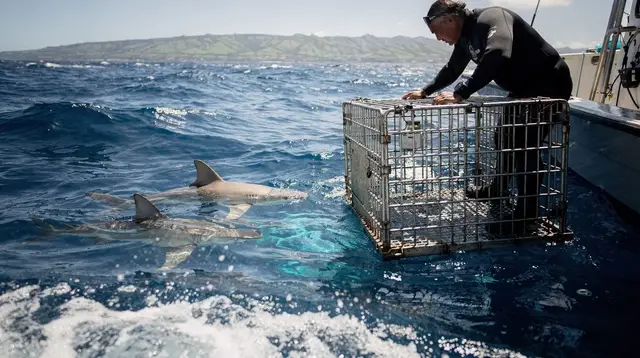
a cageless shark encounter departing from Haleiwa harboror, for a boat with a viewing cage:
a shark cage diving trip off the North ShoreNeither of these is a whale tour — winter whale odds are better run from the Waikiki or leeward side, which is day four — but both put you on the water on the same coast where the big swell lives, and they run rain or shine when surf conditions make shore-based swimming and snorkeling a bad idea anyway.
If the surf is flat this particular week, swap in the Dole Plantation (Wahiawa, free to enter) or the Polynesian Cultural Center in Laie on the drive back — it’s closed Sundays and Wednesdays, so check the calendar first.
Day 4: Whale watching, by boat and from shore
This is the day built around whales specifically. Base back in Waikiki (or Ko Olina, on the leeward side, if you started shifting that direction) and book a morning boat departure — mornings tend to have calmer water and better visibility for spotting blows on the horizon. See whale watching from Waikiki and whale watching on Oahu for how operators run these trips and what NOAA’s approach-distance rules mean in practice — no boat is allowed within 100 yards (90 m) of a whale, so binoculars matter more than a fast boat.
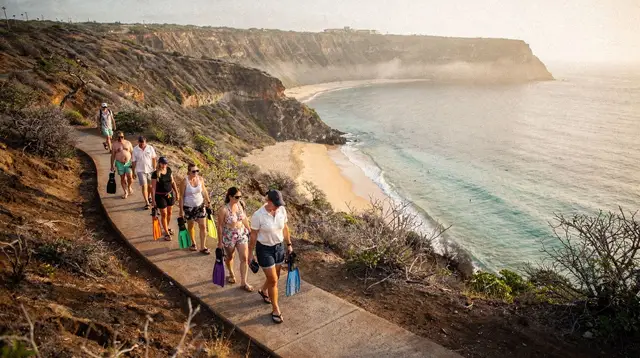
In the afternoon, add a free, land-based lookout. Makapuu Point Lighthouse Trail, on Oahu’s southeast tip, is a paved 3.2 km (2-mile) round trip with no entry fee, and it’s regarded as the best shore-based whale-watching spot on the island in winter — bring binoculars and patience. It’s an easy add-on if your boat trip departs from Waikiki, since it sits along the southeast coast on the way back. Dolphin tours and the ethics around them is worth a read too if wildlife-watching practices matter to you when choosing an operator.
Round out the evening with a second look at the water at sunset:
an evening sunset cruise along the North ShoreAgain: whales are wild animals on a migration route, not a scheduled attraction. Some winter days deliver repeated sightings: breaches, tail slaps, a mother and calf close enough to see clearly through binoculars. Other days deliver nothing more than a distant blow, or none at all. Build the day around the coastline and the chance, not around a promise.
Day 5: Honolulu, wind-down, and one more angle on the ocean
Save the last full day for Honolulu itself and a flexible finish. A morning sunrise or early climb up Diamond Head (reservation required for out-of-state visitors, booked up to 30 days ahead through the state parks system) gives one more elevated ocean view — on a clear morning, distant whale blows are sometimes visible from the crater rim, though this is a bonus, not a plan.
For the rest of the day, a city and harbor tour is a low-effort way to see Honolulu’s landmarks without driving yourself:
a half-day tour combining the USS Arizona Memorial with central Honolulu
If Pearl Harbor is new territory for your trip rather than a repeat, note that the memorial itself is free but the timed-entry reservation system fills up roughly eight weeks ahead — see Pearl Harbor tours guide and USS Arizona Memorial tickets before you count on a same-week slot.
Close the trip with an easy Waikiki evening — return the rental car if you’re flying out the next morning, since airport rental returns add extra transit time.
What this trip skips
This itinerary is built specifically around winter whales and North Shore surf, in a rental car, over five days. It doesn’t cover the more exposed hikes of Oahu’s southeast shore — those get their own dedicated coverage in Adventure Oahu, four days — and it doesn’t work through the Hanauma Bay reservation system in detail, since this route doesn’t fix a day there; if you add it, check the Hanauma Bay reservation guide first, since it’s closed Mondays and Tuesdays and books only 48 hours out. This is also not a honeymoon or family version of an Oahu winter trip — for those angles, see honeymoon Oahu, five days or Oahu with kids, five days. For a broader look at how winter compares to summer on Oahu generally, winter vs. summer Oahu and best time to visit Oahu cover the trade-offs beyond whales and surf.
Winter whales and North Shore surf: questions worth asking before you book
Will I definitely see whales on this trip?
No. Humpback whales are present off Oahu from November to May, with the best odds from January to March, but sightings depend on the animals and on weather and sea conditions that day. No boat operator or lookout point can guarantee it.
Is it safe to swim at Waimea Bay or Pipeline in winter?
Not when the surf is up. From roughly November through February, these North Shore beaches carry waves that make swimming dangerous for everyone, including experienced surfers. Watch from the beach park or designated viewing areas and follow posted lifeguard flags.
How far is the North Shore from Waikiki?
About 50 km (31 miles), roughly 45 minutes with no traffic and 1 to 1.5 hours in real conditions. This itinerary allows a full hour each way and treats the North Shore as a separate day trip, not a quick stop.
Do I need a rental car for this itinerary?
Yes. Waikiki itself doesn’t require one, but the North Shore and the coastal whale-watching lookouts in this trip aren’t practical without one. TheBus does reach the North Shore on limited routes, but it adds significant time to a schedule built around a moving swell and moving whales.
When are the North Shore surf competitions?
The Vans Triple Crown runs across the winter season, and The Eddie at Waimea Bay only happens when wave conditions meet a strict threshold, sometimes announced with a day or two of notice. Check contest websites and local surf forecasts once you’re on island rather than planning firm dates in advance.
Is Makapuu Point Lighthouse Trail a good whale-watching spot?
Yes, and it’s free. It’s a paved 3.2 km (2-mile) round trip on Oahu’s southeast coast, generally considered the best shore-based whale-watching point on the island in winter, though — as with any wildlife viewing — nothing is guaranteed.
What’s the best month to combine both whales and big surf?
January and February give the strongest overlap: whale presence is typically strong through this window, and North Shore surf is usually at its largest and most consistent, including peak competition season.
Seasonal tours and activities on GetYourGuide
Verified deep-linked GetYourGuide tours. Book through these links and we earn a small commission at no cost to you.
GetYourGuide does not provide a product photo for this activity — the image shows the meeting point, photographed by us.