The North Shore in winter: when Oahu's quiet coast turns into a surf arena
The first time I drove up to the North Shore in December, I almost didn’t recognize the coast I’d swum in that August. Same road, same sugarcane fields turning to ironwood trees along the North Shore, same little town of Haleiwa with its surf shops and shave ice stands. But the ocean had changed jobs. In summer it’s a swimming pool. In winter it’s a stage.
I’d driven up from Waikiki, the way most visitors do, north on the H-2 and then the two-lane stretch through the middle of the island before the road drops toward the coast. It’s about an hour when traffic behaves, though it never quite does on a big swell day, when half of Honolulu seems to have the same idea. I won’t turn this into a driving guide — I’ve written that one separately, on whether you even need a rental car on Oahu — but I’ll say this much: without a car, the North Shore in winter is a much harder story to be part of. If you’d rather not deal with parking along Kamehameha Highway on a big swell day, a guided North Shore day tour or a set-route one-day North Shore itinerary solves that problem for you.
What a big swell actually looks like from the sand
Nothing prepares you for the sound. Waimea Bay in summer is a hushed, turquoise cove where kids jump off the rocks. In winter, on a real north-northwest swell, it roars — a low, continuous concussion that you feel in your chest before you see the wave that made it. I stood on the sand one January afternoon and watched a set roll in that looked, from a distance, almost slow-motion: a wall of water climbing improbably high, then folding over itself with a sound like a building collapsing. People around me — locals, mostly, in beach chairs they’d clearly brought for the day — didn’t flinch. A few cheered. I flinched.
That’s the North Shore between November and March: swells generated thousands of miles away in the North Pacific arrive here with nothing to slow them down, and on the biggest days the faces at spots like Waimea Bay, the Banzai Pipeline, and Sunset Beach can reportedly push past 6 to 9 meters. Lifeguards close the swimming areas outright on those days — not as a formality, but because the water becomes lethal for anyone who isn’t a professional. I write more about what that risk actually involves, and how seriously to take the warning flags anywhere on Oahu, in a separate piece on ocean safety and rescue on Oahu’s trails and coastline; it’s worth reading before you go, not after. The same caution applies to hiking safety and permits if you’re tempted to scramble up the bluffs above Waimea for a better view.
Winter on the North Shore also overlaps with another Oahu season worth knowing about: humpback whales pass just offshore from roughly December through April, and on a clear day you can sometimes spot a spout from the same beach you came to watch surf from. If you’re trying to work out how the North Shore’s winter compares to summer more broadly, I’ve laid that out separately in a guide to winter versus summer on Oahu, and the mechanics of the swell season itself get their own dedicated North Shore surf season guide.
What struck me most wasn’t the size of the waves. It was the audience. Professional surfers paddle out in tight, tense lineups, reading a wave field that looks like chaos to me and like a chessboard to them. Photographers with lenses the length of my forearm crouch at the shoreline. A rope line and a few sunburned lifeguards keep everyone else on the sand. When the biggest events happen — the Vans Triple Crown of Surfing, or the invitational at Waimea that only runs when conditions are exactly right — the beach fills with a crowd that has nothing to do with the postcard version of Hawaii. Nobody’s in a floral shirt. Everybody’s watching the horizon.
A town that empties of one crowd and fills with another
Haleiwa in winter feels different too. The classic beach-vacation traffic — families with boogie boards, honeymooners on rental scooters — thins out. In its place comes a rougher, more specific crowd: surfers who’ve flown in from Australia, Brazil, and California with board bags longer than their rental cars, camped in converted vans along the Kamehameha Highway, living out of coolers for weeks at a time chasing a forecast. There’s an unmistakable energy to it, part pilgrimage, part encampment. Local surf shops that sell inflatable pool toys in July switch their window displays to guns — the long, narrow boards built specifically for giant waves.
I stopped in Haleiwa for shave ice on the way back that day, the way I always do, and it felt like the one constant. The rest of the town had rearranged itself around the swell, but the shave ice stand had the same line, the same rainbow syrups, the same sticky picnic tables. If you’re making the drive up, save room for that stop — I’ve written separately about where the good plate lunch and shave ice actually is on Oahu, as opposed to where the tour buses stop. Push a little further and the shrimp trucks near Kahuku are worth the detour too, winter or summer.
The same road continues past Kahuku toward Laie, where the Polynesian Cultural Center and the Dole Plantation near Wahiawa give the day a reason to keep going even if the swell turns out smaller than forecast — neither depends on the surf at all, which makes them a useful backup plan on a flat day.
The same water, a different personality
What gets me, every time I come back to this, is that it’s the exact same stretch of ocean. In July, Waimea Bay is calm enough for toddlers. Sunset Beach is a wide, gentle expanse where people fall asleep on towels. Pipeline, without the surf that made it famous, is just a pretty, unremarkable break a few dozen meters offshore. The North Pacific storms that generate the winter swells simply aren’t sending energy this way in summer, and the same coastline that closes for public swimming in January reopens as one of the most beginner-friendly stretches of sand on the island by June. I don’t think there’s another place on Oahu — maybe not another place I’ve traveled — where a single location has two such completely different identities depending on the calendar.
If you want to see the North Shore doing what made it famous, winter is the only season that does it. A guided day trip up from Waikiki is a reasonable way to see it without driving yourself, and if you’re already curious about what’s underwater along this same coast, there are shark encounters run out of Haleiwa worth knowing about too — I’ll leave the details of each below. I go into the broader case for tours versus renting a car on Oahu elsewhere, if you’re still weighing that decision.
For the drive itself, an organized Hawaii Pearl Harbor and North Shore Adventure tour covers the coast road and swings past the surf breaks without you needing to navigate the parking scrum yourself — it’s also one of the more efficient ways to pair the North Shore with a Pearl Harbor visit in the same day, an itinerary combination worth reading about on its own.
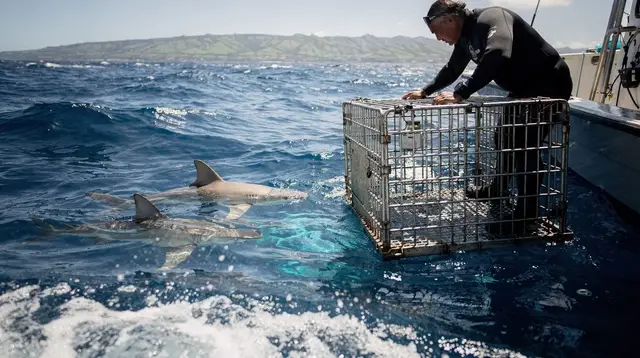
For something more specific to the water beneath those famous waves, an Oahu North Shore Cageless Shark Diving Tour or a Haleiwa: North Shore Shark Cage Diving Experience both depart from the same stretch of coast, on calmer water than you’d guess from the beach — I’ve written more about how the two compare in a dedicated North Shore shark dive guide. If you’d rather feel the North Shore’s smaller, gentler days for yourself instead of just watching from the sand, an Oahu North Shore surf lesson is best booked for the shoulder season, well outside the big winter swells — the difference between taking a lesson and just renting a board is bigger than it sounds, especially on this coast.
What I’d tell someone going for the first time
Go expecting a spectator event, not a beach day. Bring a chair, get there early if a big swell is forecast, and stay behind the rope lines — not because a sign tells you to, but because the shore break alone, even on a “small” winter day by North Shore standards, can knock an adult off their feet. Don’t plan to swim. Don’t expect the same North Shore your friend posted photos of from their July trip. And don’t rush the drive back — Haleiwa at dusk, with the surf shops closing up and the smell of grilled shrimp drifting from the trucks near Kahuku, is its own kind of ordinary that’s worth sitting in for a while.
If this is your first trip to Oahu altogether and you’re still figuring out how the North Shore fits into a wider plan, my first-time Oahu planning guide and the broader question of how many days you actually need on Oahu are both worth reading before you build an itinerary around one big swell day.
Questions people ask me about the North Shore in winter
Is it safe to visit the North Shore in winter if I don’t plan to swim?
Yes — watching from the beach or designated viewing areas is how most visitors experience the winter surf, and it’s a completely different activity from swimming. Ocean safety rules and closures exist specifically to keep spectators on land when the water turns dangerous.
When exactly does the big winter swell season run?
Roughly November through March, with the most consistent and largest swells typically arriving between December and February. Conditions vary swell by swell, so no single week is guaranteed to deliver the biggest waves.
Can I still swim anywhere on the North Shore in winter?
Some smaller, more sheltered spots stay calmer than the famous breaks, but lifeguards actively close swimming areas at spots like Waimea Bay when conditions turn dangerous. Assume the marquee breaks are for watching, not swimming, between November and March.
Do I need a car to see the North Shore surf season?
Not strictly, but it makes the trip far easier — public transit reaches the North Shore but takes considerably longer than driving. I go through the tradeoffs of renting a car versus not on Oahu in more detail elsewhere, and how TheBus and the Skyline fit into a car-free trip.
How different is the North Shore in summer?
Almost unrecognizable. The same beaches that close for surf in winter become calm, family-friendly swimming spots from roughly May through September, with flat water where the winter swells had been breaking.
Is it worth visiting the North Shore in winter if I don’t surf?
Yes — watching professional surfers navigate genuinely massive waves from the sand is a memorable experience on its own, and the town’s atmosphere during a big swell is unlike anywhere else on Oahu.
Where should I stop for food on the way up or back?
Haleiwa has the classic shave ice and plate lunch spots, and the shrimp trucks near Kahuku are a North Shore institution in their own right. I’ve written a separate piece on where the good food actually is, as opposed to the tourist-trap version. And if you’re planning around a specific window, my best time to visit Oahu guide covers how the North Shore’s winter swell season lines up with the rest of the island’s calendar.
Seasonal tours and activities on GetYourGuide
Verified deep-linked GetYourGuide tours. Book through these links and we earn a small commission at no cost to you.
GetYourGuide does not provide a product photo for this activity — the image shows the meeting point, photographed by us.