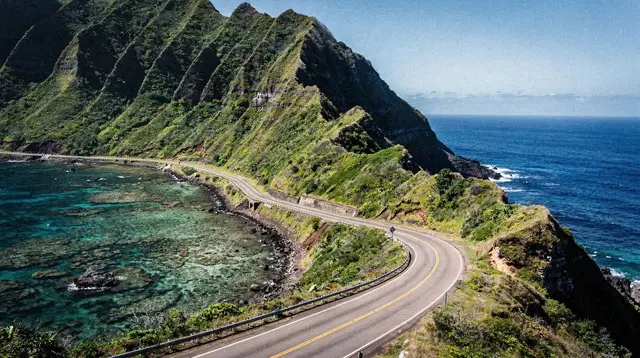
Tandem skydiving over the North Shore
Where do you go skydiving on Oahu, and what does the jump involve?
Tandem jumps leave from Dillingham Airfield on the North Shore, about an hour from Waikiki. The plane climbs to roughly 14,000 feet, freefall lasts about a minute, then you fly under canopy for several minutes over the coast and old pineapple fields before landing back at the airfield.
Tandem skydiving on Oahu happens in one place: Dillingham Airfield, a small strip on the North Shore’s northwest coast near Mokuleia. It is the only place on the island where you can jump, and it is worth being clear about that before you plan a day around it, because the airfield is not on the way to Haleiwa or Waimea Bay — it is a separate destination with its own hours and its own approach road.
Getting to Dillingham Airfield
From Waikiki, the drive to Dillingham takes about an hour in normal traffic, longer during the morning commute out of Honolulu. The route runs on the H-1 and H-2 west and north across the island, then follows the Kamehameha Highway along the northwest coast past Waialua toward Mokuleia. This is not the same road you take to reach the surf beaches of North Shore proper — Waimea Bay, Sunset Beach, and Pipeline sit further east, closer to Haleiwa. Dillingham is its own turn, with its own small entrance and parking lot, and it is easy to miss if you are expecting a surf-town scene. There is no public transit option that reaches the airfield in a practical way; a rental car or a booked transfer is the only realistic way in.
A rental car is the simplest way to make the trip work on your own schedule rather than around a shuttle’s timetable — see our guide to renting a car and parking on Oahu for what to expect on the H-1/H-2 drive and at the airfield’s own small parking area. If you would rather not drive, some operators offer a paid shuttle from Waikiki hotels as part of the booking; ask when you reserve, since it adds to the total time away from your day rather than shortening it, and pickup windows are usually earlier than a self-drive morning slot would require.
Because the drive out is long, some visitors pair the trip with other things to do nearby, either before or after a jump: gliding operations also run from the same airfield, and the Dole Plantation and Haleiwa town are both a reasonable detour on the way back toward Honolulu. A half day North Shore scenic tour covers some of that same ground for visitors who want to see the coast without arranging their own drive.
The jump itself
Tandem skydiving pairs each jumper with a certified instructor for the entire flight, freefall, and landing — no solo experience or certification is required. The sequence is straightforward:
- Check-in and gear. Arrive at the scheduled time, sign waivers, and get fitted with a harness. Weigh-in happens here against the operator’s posted weight limit.
- The climb. The plane climbs for roughly 15 to 20 minutes, gaining altitude over the coast. Most Dillingham operators jump from around 14,000 feet, though this varies slightly by company and by aircraft.
- Freefall. About a minute of freefall at close to terminal velocity, before the instructor deploys the parachute.
- Under canopy. Several minutes of a much calmer descent, with time to take in the coastline, the old pineapple fields inland, and the Waianae Range to the south before landing back on the airfield.
The view during the canopy ride is the part most people remember: the North Shore’s undeveloped coastline stretching in both directions, the patchwork of former pineapple and sugarcane land inland, and on a clear day the outline of Kauai on the horizon to the northwest. Between December and April, humpback whales sometimes pass in the waters offshore and are occasionally visible from the plane or under canopy — a possible bonus, never something an operator can promise.
Booking and timing
Morning departures are generally the more reliable choice. Hawaii’s trade winds and cloud cover tend to build through the day, and operators will delay or cancel afternoon loads when winds or visibility drop below their safety thresholds. Booking an early morning slot, particularly on weekends when demand is highest, reduces the odds of a weather-related reschedule eating into your day. Weekday mornings tend to have more flexibility for same-day changes if conditions shift.
Reserve ahead rather than counting on a walk-in slot, especially Friday through Sunday. Weather holds are common enough on the North Shore that a fully booked morning can push same-day arrivals to a later slot or a different day entirely — not something you want to discover after the hour-long drive out from Waikiki.
A weather hold is a normal part of skydiving on a coast with steady trade winds, not a sign that anything went wrong with your booking. Most operators rebook a canceled load for the next available slot rather than guaranteeing a same-day makeup, so building a buffer into your schedule — especially if you are flying home soon after — matters more here than for most North Shore activities.
Our booking-ahead guide covers which Oahu activities are worth reserving weeks out versus days out; skydiving sits firmly in the plan-ahead category because of both steady demand and weather sensitivity. If you are still choosing which week of your trip to fly in, Oahu’s best time to visit breaks down the dry season, roughly May through October, when trade winds and cloud buildup tend to be more predictable, and our hurricane season guide covers the June-through-November window when a tropical system can affect flight schedules island-wide, skydiving included.
Weight and age limits
Every operator publishes a maximum weight limit for tandem jumpers, commonly somewhere in the 220 to 250 pound range, sometimes expressed as a combined limit for the jumper-and-instructor pair. These limits exist for safety and are enforced at check-in with an actual weigh-in, not on the honor system, so it is worth confirming the specific number with whichever operator you book rather than assuming a figure from a different company.
Minimum age requirements also vary. Most operators require jumpers to be 18 with valid photo ID; a handful allow younger jumpers with notarized parental or guardian consent. As with weight limits, confirm directly with the operator you are booking, since Hawaii state law does not set a single statewide minimum for tandem skydiving.
| Practical detail | What to expect |
|---|---|
| Departure point | Dillingham Airfield, North Shore (not Haleiwa or the surf beaches) |
| Drive from Waikiki | About 1 hour each way |
| Typical jump altitude | Around 14,000 feet |
| Freefall time | About 60 seconds |
| Canopy ride | Several minutes |
| Weight limit | Commonly 220–250 lb, varies by operator |
| Minimum age | Typically 18, some allow younger with consent |
| Best time slot | Morning, before trade winds and clouds build |
| Booking | Reserve ahead, especially weekends |
Pricing
Tandem jumps are sold at a base rate for the jump itself, with photo and video packages — handheld video from the instructor, a helmet-camera angle, or both — offered as paid add-ons. Prices and package structures change and differ between operators, so check current rates directly with the company or booking platform rather than relying on a figure that may be out of date. Note that Hawaii’s roughly 4.5 percent general excise tax applies on top of the quoted price.
What to bring and expect at check-in
Wear closed-toe shoes and clothing you can move in; loose layers work better than anything bulky, since you will be strapped into a harness for the climb and freefall. Leave loose items like hats, sunglasses on a flimsy strap, or anything you are not willing to lose behind in your car — operators typically require securing or removing personal items before boarding. Arrive at or before your scheduled check-in time, since the weigh-in, waiver signing, and harness fitting all happen before the group is called for its flight, and a late arrival can bump you to a later load if the day’s schedule is full.
Most operators photograph or film every jump as a paid add-on, but a few allow jumpers to bring their own mounted camera with prior approval. Confirm this when booking rather than assuming it is allowed, since some companies restrict personal cameras during freefall for safety reasons.
Making a full day of the North Shore
Because the drive out and back eats a chunk of the day, many visitors build the rest of their North Shore time around the jump rather than treating it as a separate trip. A one-day North Shore itinerary works well on either side of a morning skydive, covering Haleiwa town, the surf beaches, and the shrimp trucks at Kahuku for lunch. If your trip falls in winter, pair the day with our humpback whale season guide to know what else the coast looks like at that time of year — big winter surf closes some beaches to swimming even as it draws watchers to Waimea Bay and Pipeline. For a broader look at Oahu in winter, including how skydiving and whale watching can fit into the same week, see winter Oahu: whales and surf.
What this page does not cover
This guide is about the skydiving experience specifically — the plane, the freefall, and the canopy ride from Dillingham. It does not cover helicopter tours of the North Shore or the rest of Oahu, which are a separate activity with different operators, aircraft, and vantage points; see our helicopter tours guide for that, including the doors-off-versus-doors-on choice covered separately. If you are deciding between the two experiences, skydiving gives you a minute of freefall followed by a slow descent under a parachute canopy; a helicopter tour keeps you seated in a cabin for a longer, steadier flight built around sightseeing and photography rather than freefall.
Other things to plan around the trip
Given the drive time, most visitors treat a North Shore skydive as most of a morning or a half day. If you want to make a fuller day of the trip, the North Shore day tour options cover Haleiwa, the surf beaches, and the shrimp trucks at Kahuku, though skydiving itself is typically booked separately from these guided tours rather than as part of one. For visitors weighing whether winter is the right season for a North Shore trip at all — bearing in mind the big surf that closes some beaches to swimming — see our North Shore surf season guide and whale watching guide for what else is happening on that coast at the same time of year.
If you would rather explore the North Shore coastline on two wheels before or after a jump, a guided electric bike tour out of Haleiwa covers some of the same coastal stretch at a much slower pace. And for visitors who want an adrenaline activity on the North Shore without going airborne, cageless shark diving tours depart from Haleiwa harbor rather than Dillingham Airfield — a different kind of North Shore excursion worth knowing about if skydiving turns out to be booked up or weathered out on the day you visit.
Booking a North Shore skydive or related North Shore activities
Oahu: North Shore Cageless Shark Diving Tour and Haleiwa: North Shore Shark Cage Diving Experience are separate North Shore adrenaline outings departing from Haleiwa harbor rather than Dillingham Airfield, worth considering as an alternative if a skydiving slot is unavailable on your dates. For a lower-key way to see the same coastline, Oahu: Half Day North Shore Scenic Tour covers Haleiwa, the surf beaches, and Kahuku by van. If you want to try the water yourself, North Shore: Oahu Surf Lessons runs on the calmer summer swell, a good pairing with a morning skydive on the same North Shore trip.
Skydiving on the North Shore: frequently asked questions
Where exactly do North Shore skydiving flights depart from?
From Dillingham Airfield, a small general-aviation strip on the northwest coast near Mokuleia, not from Haleiwa town or any surf beach. It has its own gate, parking area, and check-in office separate from the North Shore’s surf spots.
How high do you go and how long is the freefall?
Tandem operators at Dillingham typically climb to around 14,000 feet, giving roughly 60 seconds of freefall before the parachute opens for a several-minute ride under canopy.
Is there a weight limit for tandem skydiving?
Yes. Operators impose maximum weight limits, commonly in the 220 to 250 pound range depending on the company, sometimes with a combined tandem-pair limit as well. Check the specific operator’s policy when booking, since limits vary and are enforced at check-in.
What is the minimum age?
Most Oahu operators require jumpers to be at least 18 with valid photo ID; a few allow younger jumpers with notarized parental consent. Confirm the age policy directly with the operator before booking, since it is not uniform across companies.
Can you see whales while skydiving?
In winter, roughly December through April, humpback whales pass off the North Shore coast and are sometimes visible from the plane or under canopy on a clear day. It is a possible bonus, not a guarantee, and depends on conditions and where whales happen to be that day.
What time of day is best to book?
Morning slots are usually the most reliable. Trade winds and cloud buildup tend to increase over the course of the day, and operators sometimes shift or cancel afternoon loads when conditions turn, so an early booking reduces the chance of a weather delay.
How much does it cost, and is video included?
Tandem jumps are sold at a base rate for the jump alone, with photo and video packages offered as add-ons at extra cost. Check current pricing directly with the operator or booking platform, since rates and package structures change.
Do I need to book in advance?
Yes, especially for weekends, when morning slots fill first. Same-day availability exists but is not reliable, and a canceled or weather-delayed slot can push a walk-in booking out of the day entirely.
Helicopter and air tours over Oahu on GetYourGuide
Verified deep-linked GetYourGuide tours. Book through these links and we earn a small commission at no cost to you.
GetYourGuide does not provide a product photo for this activity — the image shows the meeting point, photographed by us.