What aloha actually means
I have lost count of how many places on Oahu sell the word aloha. It is on tee shirts folded in neat stacks on Kalakaua Avenue, on the awning of a poke shop, on the name of a tour bus, on a welcome sign at the airport before you have even collected your bags. Say it back to the person at the rental car counter and you get a genuine smile. Somewhere in that transaction, though, a word that means something quite specific and quite demanding in Native Hawaiian culture has been worn down into a greeting, a sign-off, and a brand.
I want to try to describe the difference, because I think it matters for anyone spending time on this island, and because getting it wrong is an easy, understandable mistake.
A word that asks something of you
In the way I have heard it explained by Native Hawaiian friends and in the way it shows up in how people actually behave here, aloha is not primarily a feeling you have. It is closer to a standard you are held to. It carries the idea of reciprocity: if someone extends care to you, land included, you owe something back. It carries respect for elders, for family, for people you have just met and may never see again. It carries a felt responsibility toward the land itself, the idea that a place is not just scenery you consume but something you are in relationship with and accountable to.
That is a very different object from “hello” printed on a keychain.
None of this means the touristic greeting is fake or that using it is rude. Visitors are not expected to arrive already fluent in a worldview. The friction comes from something narrower: an entire industry, my own included in the sense that this site exists because of tourism, has taken a word with deep obligations attached and sold it as atmosphere. A resort can call its lobby the “Aloha Court” without asking anything of the resort or the guest in return. That gap, between a word that historically demanded something and a word now used to sell a room upgrade, is what some Native Hawaiians find genuinely wearing, especially when it is repeated by people who are here for four days and leave nothing behind but a good review.
Where you can actually see it, not just hear it
The clearest place I have felt the difference between the two uses of aloha was not at a luau or in a gift shop, but in ordinary interactions that have nothing to do with tourism at all. A driver on the H-1 who lets three cars merge in front of him with a shaka out the window, no horn, no irritation. A stranger at a Chinatown market who walks you to the stall you were looking for instead of just pointing. An older woman at a bus stop near Kapiolani Park who asked where I was from, and then spent five minutes making sure I knew which bus actually went to Diamond Head, unprompted, expecting nothing back. None of these people said the word aloha. They did not need to. The behavior was the thing.
That Chinatown encounter was not a one-off. It is the kind of thing that tends to happen when you slow down enough to actually walk a neighborhood instead of photographing it from a bus window, and it is a big part of why I wrote a separate Chinatown food walk guide the way I did, as a route built around talking to people at the stalls, not just eating your way down the block. The bus stop conversation is the same story in a different setting. Honolulu’s public bus system, TheBus, is not fast and it is not glamorous, but riding it puts you next to the people who actually live here in a way a rental car never will, and I laid out how it works, along with the newer Skyline rail, in a guide on TheBus and Skyline.
Compare that with an activity company that stamps “Aloha Adventures” on its van and offers nothing distinct from any tour operator anywhere else in the world. The word is doing marketing work there, not cultural work. I do not think that makes the company dishonest, exactly, but it is worth noticing the difference as a visitor, because it changes what you should expect. A branded greeting is not a cultural exchange, and treating it as one can flatten a place into scenery.
This is part of why I keep coming back to the point that Waikiki is a real, dense, commercially built neighborhood, not the whole island and not a stand-in for Hawaiian culture. I wrote more about that gap separately, in a piece on why Waikiki is not the whole island, and I think it applies just as much to language as it does to geography.
The luau problem, briefly
Luaus sit right at the center of this tension, which is why I am not going to resolve the question here. A modern commercial luau, whether it is a beachfront show near Waikiki or a larger production elsewhere on Oahu, is a paid entertainment product with a script, a schedule, and a bar. That does not automatically make it hollow. Some are produced by Native Hawaiian performers who take real pride in the material, and some visitors leave with a genuinely better sense of Polynesian history and dance than they had walking in. But it is fair to ask what is being sold, and to whom the proceeds and the storytelling authority actually belong. If that question interests you beyond a single evening’s entertainment, I laid out the arguments on both sides in a separate piece on the luau authenticity debate, and I would rather point you there than try to settle it in a few paragraphs here.
What I will say plainly: booking an evening like the Queens Waikiki Luau or the Kaula luau show with optional dinner is a reasonable way to spend an evening, and I have enjoyed both kinds of shows on this island. Just go in knowing it is a production, not an anthropology lesson, and it will sit better with you either way.
If you want the fuller picture before you book, I would read a plain rundown of what to expect at a luau so the evening does not feel like a surprise, and a separate roundup of the best luaus on Oahu if you are still deciding which one fits your trip.
What this looks like at Pearl Harbor
Even a site as historically weighted as Pearl Harbor is not immune to the word getting stretched thin. I have seen tour listings that put “aloha” directly in the name of a Pearl Harbor itinerary, the way one operator’s own USS Arizona Memorial and Honolulu tour does, or the way a broader Pearl Harbor and Honolulu city tour gets marketed. It is not wrong, exactly, but it is a small, telling example of how far the word now travels from its original weight: attached to a memorial for a military attack, because it reads as warm and welcoming on a booking page. I do not think there is malice in it. I think it is what happens when a word becomes shorthand for an entire place rather than a description of how people are meant to treat each other.
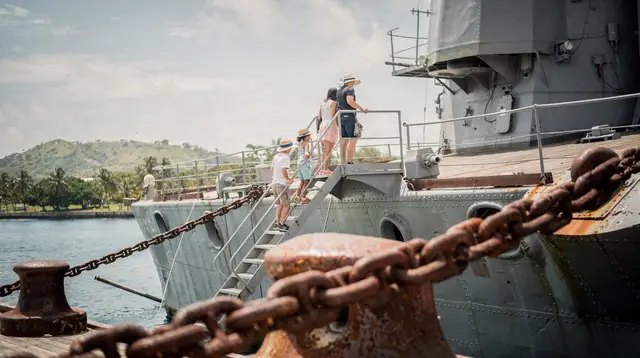
For what it is worth, the memorial itself resists the marketing gloss better than most sites on the island: the USS Arizona Memorial is free to visit, run by the National Park Service, and the experience is somber by design, not styled as an aloha welcome. If you are planning that visit, I would start with a straight guide to USS Arizona Memorial tickets for the booking logistics, and a broader Pearl Harbor tours guide if you are weighing a self-guided visit against a packaged tour.
What I try to do with it
I still say aloha, out loud, often, because it is the word people here use and because refusing to use it would be its own kind of awkward performance. But I try to hold the two meanings apart in my head: the friendly, low-stakes greeting that costs nothing and offends no one, and the older, heavier idea of reciprocity and care that Native Hawaiians are describing when they talk about aloha as a value under pressure from an industry, mine included, that has borrowed their word without always carrying its weight. You do not need to resolve that tension to visit Oahu well. You just need to know it exists, and to notice, more often than the shirts and the signage ask you to, the ordinary moments where the real thing is actually happening.
If this is your first trip and you are still building out the rest of your plan, my first-time Oahu planning guide covers the logistics I have not gotten into here, and a list of free things to do on Oahu is a decent place to notice the ordinary version of aloha, since none of it involves buying anything.
Aloha, luau culture, and visiting Oahu with respect
Is it disrespectful for a visitor to say aloha?
No. Saying aloha as a greeting is normal and welcomed. What can land badly is using it as decoration, mispronouncing it deliberately for a joke, or treating it as proof that you already understand the culture.
Why does the tourism industry get criticized for using aloha?
Because a value rooted in reciprocity and care for people and land gets flattened into a marketing word attached to hotels, tour names, and souvenirs, with none of the obligation the word carries for Native Hawaiians.
Where does the word aloha come from?
It comes from Native Hawaiian language and worldview, where it describes a relationship of mutual respect and responsibility between people, and between people and the land, not a single feeling or a slogan.
Does every local person feel the same way about the word’s tourist use?
No. Opinions vary widely, from indifference to real frustration, and I only describe what I have seen and heard on Oahu, not a single official position.
Is the aloha spirit the same as Hawaiian hospitality?
They overlap but are not identical. Hospitality is one expression of aloha, but the value itself is broader, covering how people are expected to treat land, elders, and community, on and off the clock.
How can a visitor experience aloha as more than a word?
By paying attention to how people actually treat each other and the land here, at a luau, on a trail, in traffic, and by treating that as something to observe and respect rather than a photo backdrop.
Is a commercial luau a bad way to see Hawaiian culture?
Not necessarily, but it is a commercial show, and it is worth knowing that going in. The debate over what luaus do and do not represent is worth its own read.
tours.Culture
Verified deep-linked GetYourGuide tours. Book through these links and we earn a small commission at no cost to you.
GetYourGuide does not provide a product photo for this activity — the image shows the meeting point, photographed by us.