Wheelchair-accessible tours and excursions on Oahu
What are the most wheelchair-accessible tours on Oahu?
Pearl Harbor's USS Arizona Memorial program uses a ramped Navy shuttle boat and is one of the most reliably accessible excursions on the island. Custom private van tours with a wheelchair-accessible vehicle, the Waikiki submarine tour's shoreside boarding, and the Polynesian Cultural Center's paved grounds also work well, but each needs advance notice, not a same-day request.
What “accessible” means on an Oahu tour listing
Tour marketing on Oahu uses the word “accessible” loosely, and it rarely tells you whether that means a ramp, a lift, a wide door, or just a flat parking lot next to a building with steps. This guide looks past the label and lists what actually works in a wheelchair: the boarding method, the aisle or doorway width where it is known, and what part of an excursion is not accessible even when the rest is. For the island’s general infrastructure — sidewalks, curb cuts, beach mats, and accessible parking rules — see accessible Oahu, which this page does not repeat. Here the focus is narrower: which bookable excursions hold up for a wheelchair user planning a specific day.
The short version: Pearl Harbor’s core memorial program is genuinely accessible and free. A handful of paid attractions nearby are only partly accessible. Boat tours vary by vessel and need a phone call, not just an online booking. Land tours in a private van beat fixed-route buses for flexibility. And at least one signature Oahu attraction — Diamond Head — has no accessible route at all, so this guide names the honest alternative rather than pretending otherwise.
Pearl Harbor: the most reliably accessible excursion on the island
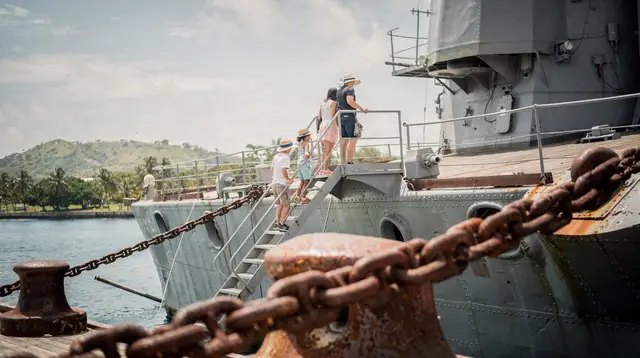
The Pearl Harbor National Memorial visitor center, its two museums, and the orientation theater are step-free, with paved paths and ramped entrances throughout. The program that takes visitors to the USS Arizona Memorial itself — a short film followed by a Navy-operated shuttle boat — uses a boat with a ramp and designated wheelchair spaces, and staff assist with boarding. This is the single most dependable accessible excursion on Oahu, and it is free aside from the roughly 1 USD recreation.gov booking fee.
The catch is booking, not access. Reservations open eight weeks ahead at 15:00 Hawaii time and sell out fast; note the mobility requirement when you book so staff can plan the shuttle boarding order. See Pearl Harbor from Waikiki transport for getting there without a rental car, and Pearl Harbor half-day vs. full-day for how much time the accessible route through all four sites actually takes.
The three paid attractions next to the memorial are not uniformly accessible, and conflating them with the free memorial is the single most common mistake in trip planning here:
| Site | Wheelchair access | What is not accessible |
|---|---|---|
| USS Arizona Memorial (free) | Ramped Navy shuttle boat, accessible theater and center | — |
| USS Missouri (paid) | Elevator to the main deck and some interior spaces | Many original passageways, ladders, lower decks |
| USS Bowfin submarine (paid) | Not accessible | Entire vessel — narrow original hull, ladders only |
| Pearl Harbor Aviation Museum (paid) | Paved hangar floors, ramped entrances | A few elevated platforms in older hangar sections |
If a chair user wants to see the USS Missouri, call ahead to confirm which sections of the deck the elevator reaches that day, since maintenance occasionally limits it. The Bowfin is realistically not an option for a wheelchair visit — treat any “accessible” claim about it with suspicion.
For families combining the memorial visit with an accessible-minded schedule, Pearl Harbor with kids has useful pacing notes that also apply to a visitor using a wheelchair, since both benefit from the same slower, non-rushed route through the four sites.
Custom private van tours: the most flexible option
A fixed-route group tour bus on Oahu is usually a standard motorcoach with steps and no lift. For a wheelchair user, a custom private tour in a specifically requested wheelchair-accessible van is the more workable format, because the vehicle, the stops, and the pace are all negotiated in advance rather than fixed by a printed itinerary.
A fully customized private itinerary around Oahu, where the accessible vehicle and stop list are agreed with the operator before the day starts is built for exactly this: you describe the mobility equipment (manual or power chair, folding or rigid frame, approximate weight) when booking, and the operator confirms whether their van has a ramp or a lift and how wide the door opening is. Do this in writing at least two to three weeks ahead — accessible vans are a small fraction of the private-tour fleet on the island, and they are not swapped in on request the morning of a tour.
A small-group private tour that can be tailored to specific accessible stops around the island works the same way, and is worth comparing on price and vehicle type before booking either one. Both let you skip stops that are not practical in a chair — a lava-rock overlook with no paved path, for instance — in favor of paved viewpoints, accessible restrooms, and a slower boarding routine.
See private tours vs. group tours for the general trade-offs, and private tours on Oahu for the wider list of operators; neither page is accessibility-specific, so always confirm vehicle type directly with the operator rather than assuming from the listing.
A circle-island itinerary built this way can still hit most of the standard stops — the Nuuanu Pali lookout, a North Shore beach town stop, and a Pearl Harbor visit — as long as each is checked individually for a paved, step-free path from the parking area. The general best-of-Oahu island tour format runs on a standard bus and is not a wheelchair option unless the operator confirms an accessible vehicle for that specific departure.
Boat and water excursions: check the boarding method, not the brochure
Boat tours are the category where “accessible” claims mislead the most, because access depends entirely on the individual vessel and the dock or beach used that day, not on the tour company’s general policy.
The Waikiki submarine tour, which boards from a shoreside catamaran rather than the submarine’s own hatch is one of the more workable water excursions for a chair user: passengers transfer to the submarine itself via a boarding platform, and staff assist with the transfer, but the submarine’s interior seating is fixed and not usable for someone who cannot transfer out of a wheelchair independently or with assistance. Call ahead to confirm the day’s boarding platform and whether a transfer aid is available.
Sunset catamaran cruises and dinner cruises out of Waikiki generally board by a beach or dock ramp, but almost none can take a wheelchair below deck into an enclosed cabin — expect to stay on the open main deck, which is usually where the views and the buffet line are anyway. A glass-bottom boat or the submarine tour above are better bets than an open snorkel-cruise catamaran, where boarding is often a step down from a low platform with no ramp at all.
The rule for every boat excursion: phone the operator, describe the chair (manual, power, weight, folding or rigid), and ask specifically whether boarding uses a ramp, a lift, or a step, and whether the accessible route reaches the seating area you’d actually use for the trip — not just the dock.
Cultural excursions: Polynesian Cultural Center and luau options
The Polynesian Cultural Center in Laie has paved, step-free pathways through its main village grounds and canal-side walkways, and the outdoor evening show has both standard and accessible seating areas — request accessible seating when booking, since it is limited and placed for sightlines over the raised stage. Some of the individual village demonstration huts sit on raised wooden platforms without ramps, so expect to view a few of these from ground level rather than entering them.
Chief’s Luau, held at Sea Life Park with covered outdoor seating and a step-free approach from the parking area is a workable choice for a wheelchair user planning a luau evening; request accessible seating at booking so the table assignment accounts for a chair rather than a bench. Compare it against other formats at luau what to expect and Chief’s Luau vs. Paradise Cove, neither of which is accessibility-specific, so confirm seating directly with the venue regardless of which one you pick.
A full-day circle-island tour that includes cultural and scenic stops around Oahu is worth checking against the accessible-vehicle question above before booking — the standard version runs on a regular tour bus, so ask specifically whether an accessible departure exists before assuming the “island tour” label covers it.
Where there is no accessible option, and what to do instead
Some of Oahu’s best-known viewpoints have no accessible route, and it is more useful to say so plainly than to suggest a workaround that does not exist.
Diamond Head has no accessible path to the summit: the trail is roughly 1.3 km one way with stairs, a narrow tunnel, and an unpaved, steep grade, and the reservation system does not offer any alternate accessible route. For a comparable coastal panorama, a paved lookout reached by car or a sunset boat excursion is the realistic substitute, not the crater trail itself.
Manoa Falls and most of Oahu’s waterfall hikes run on unpaved, often muddy forest trails and are not wheelchair accessible in any season. Kualoa Ranch’s guided tours — see Kualoa Ranch — run mainly on UTV, horseback, or open-air bus, and while the bus-based movie-sites tour has step access assistance at boarding, the ranch grounds themselves are unpaved in most areas; call the ranch directly to ask about their bus tour’s boarding equipment before booking.
Booking ahead: the single most important habit
Every excursion above that actually works in a wheelchair works because someone booked it with the mobility need stated in writing, days or weeks ahead — never as a same-day walk-up request. Accessible vans, ramped boats, and reserved accessible luau seating are a small share of what each operator runs, and they are allocated to whoever asks first, not assigned automatically to whoever shows up.
A practical booking order for a trip built around accessibility: reserve the Pearl Harbor shuttle as soon as the eight-week window opens, since it is free and the most reliable option on the island; book a private van tour operator directly by phone or email describing the chair, at least two to three weeks out; and confirm luau or boat seating in writing rather than assuming a general “accessible” tag on a listing covers your specific equipment. For getting between Waikiki and the airport with mobility equipment, see HNL to Waikiki options and Honolulu airport transfers, both of which cover accessible transfer vehicles separately from standard rideshare.
Wheelchair-accessible tours on Oahu — frequently asked questions
Is the USS Arizona Memorial wheelchair accessible?
Yes. The visitor center, museums, and theater are step-free, and the Navy shuttle boat to the memorial itself has a ramp and wheelchair spaces. Reserve early through recreation.gov and note the mobility need in the booking.
Can I visit Pearl Harbor’s other ships in a wheelchair?
The USS Missouri has elevator access to the main deck and select interior spaces, but many original passageways and ladders below deck are not accessible. The USS Bowfin submarine is not wheelchair accessible; its interior is a narrow original submarine hull with ladders.
Is Diamond Head accessible for wheelchair users?
No. The trail has stairs, a narrow tunnel, and a steep unpaved grade, and there is no accessible route to the summit. A wheelchair-friendly alternative for a similar coastal view is a paved lookout or a boat-based sunset tour instead.
Do Oahu catamaran and sunset cruises take wheelchairs?
Some do, with limits. Boarding usually means a ramp or a short lift from a dock or the beach, and most boats cannot take a wheelchair below deck or into the cabin. Call the operator directly before booking and describe the chair (manual or power, folding or not).
Is the Polynesian Cultural Center wheelchair accessible?
The main grounds, village pathways, and the luau seating areas are paved and step-free. Some individual village demonstrations sit on raised platforms without ramps, and the evening show has both accessible and standard seating, so request accessible seating when booking.
How far in advance should I book an accessible tour on Oahu?
For Pearl Harbor, book through recreation.gov as soon as the eight-week window opens. For private van tours, luaus, and boat tours, book at least two to three weeks ahead and state the mobility equipment in writing, since accessible vehicles and boarding ramps are limited in number.
Are private tours a better option than group tours for wheelchair users?
Often yes. A private tour lets you request a specific wheelchair-accessible vehicle, control the pace at each stop, and skip attractions that are not practical in a chair, which a fixed-route group bus cannot offer.
Accessible tours on Oahu on GetYourGuide
Verified deep-linked GetYourGuide tours. Book through these links and we earn a small commission at no cost to you.
GetYourGuide does not provide a product photo for this activity — the image shows the meeting point, photographed by us.