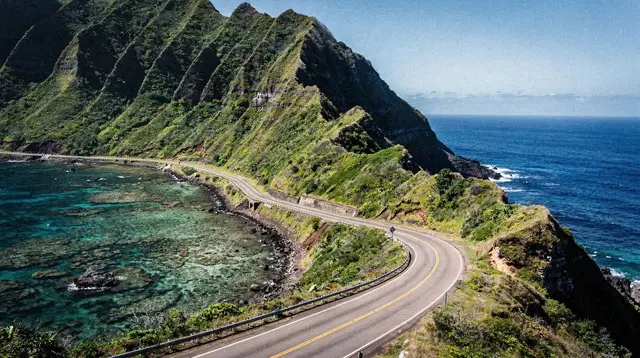
Small-group island tours of Oahu
What is a small-group island tour of Oahu, and is it worth the extra cost?
It is a circle-island tour run in a van of roughly 10 to 15 seats instead of a 25-to-50-seat bus, usually with more stops and more time at each one. It typically costs more per person than a standard bus tour, not less, in exchange for fewer passengers, a more flexible route, and a guide who can actually answer questions.
What a small-group tour actually is
A small-group island tour of Oahu is the same basic idea as a standard circle-island bus tour — one guided day that strings together the windward coast, the North Shore, and often the southeast shore — run in a van instead of a full-size motorcoach. Instead of 25 to 50 passengers, the vehicle typically holds somewhere between 10 and 15 people, and a handful of listings go further and cap the group at a single private party.
The route is not a different island. It is the same landmarks a large bus tour visits: the Nuuanu Pali overlook, the windward coast around Kaneohe, the Kualoa area, and a run up to the North Shore for Waimea Bay, Haleiwa, and the shrimp trucks in Kahuku. What changes is the vehicle size, the group size, and, often, the pacing.
Why the smaller vehicle changes the day
Three things follow directly from having fewer seats on board.
More time per stop. A 50-passenger bus has to plan tight windows at each viewpoint because loading and unloading that many people takes real minutes. A van with 10 to 15 seats gets everyone on and off in a fraction of the time, which the operator can spend on the road instead — either a longer stop, an extra stop, or both.
A guide who is actually reachable. On a full bus, the driver-guide narrates over a microphone to a room of strangers and rarely fields individual questions. In a van, the same person is a few feet from every passenger, and asking about a plant, a place name, or the history at Pearl Harbor tends to get a real answer rather than a repeated script.
Access to smaller roads and viewpoints. Some pullouts and short side roads on the windward coast and North Shore are narrow enough that a full-size bus cannot stop there safely, or the operator is not permitted to. A van has more places it can pull off, which sometimes shows up as an extra overlook or a quieter beach access that a big-bus route skips entirely.
None of this makes the small-group format a fundamentally different itinerary. It is the same island, the same handful of headline stops, delivered with more room to breathe.
What it costs, honestly
This is the point most worth getting right before booking: a small-group tour is generally more expensive per person than a standard bus tour, not less. The operator is spreading the same fixed costs — driver, fuel, guide, permits, insurance — across a much smaller number of paying seats, so the per-person price has to be higher to cover the day.
| Format | Typical group size | Price positioning | What you’re trading |
|---|---|---|---|
| Standard bus tour | 25–50 passengers | Lowest per-person price | Less flexibility, tighter stop times, one central pickup |
| Small-group van tour | 10–15 passengers | Noticeably higher per-person price | More time on site, more direct guide access, sometimes extra stops |
| Private/custom tour | Your party only | Highest, usually a flat rate per group | Full control of stops and pace, at a fixed cost regardless of group size |
The gap between a standard bus tour and a small-group van can be substantial, and it widens further for a fully private tour billed at a flat rate per party. If keeping the day’s budget down matters more than legroom and flexibility, the standard circle-island tour is the better fit. If you would rather spend more for a calmer pace and a guide you can actually talk to, the small-group format earns its price. Never assume “small group” means “budget option” when comparing listings — check the per-person price against a standard bus tour on the same route before booking.
A typical day, start to finish
Most small-group circle-island tours run as a full day, roughly 8 to 10 hours from the first Waikiki pickup to the last drop-off. A rough shape looks like this:
- Early hotel pickup, generally starting between 7 and 8 a.m.
- Windward coast stops — the Nuuanu Pali overlook, a photo stop along Kaneohe Bay, sometimes a short beach visit near Kailua or the Kualoa area.
- North Shore stretch — a stop in Haleiwa, a look at Waimea Bay or one of the surf beaches (conditions and specific stops vary by season and operator), and often a food stop at the Kahuku shrimp trucks.
- Return drive, with a possible additional overlook or beach stop on the way back depending on time and traffic.
- Drop-off back at Waikiki hotels, typically mid-to-late afternoon or early evening.
Because the vehicle is smaller, pickup is rarely a single meeting point. Expect the operator to route through several Waikiki hotel stops before heading out, which can add 20 to 40 minutes to the start of the day compared with a tour that gathers everyone at one central plaza. Check your confirmation for the exact pickup time and location; a small van running a multi-stop pickup has less slack in its schedule than a large bus with one loading point, so being ready a few minutes early matters more here than on a standard tour.
Booking timing — fewer seats fill faster
The trade-off for a smaller, more flexible vehicle is fewer seats overall, and those seats sell out well before a standard bus tour does. If you have specific dates, especially in the winter months (November through April) when North Shore surf season and whale season both draw crowds, or around U.S. holidays, book a small-group tour at least a few weeks ahead. Waiting until the week of your trip is a reasonable gamble on a large bus tour that runs multiple daily departures; it is a poor one on a van that seats 12.
How to choose between the formats
If your priority is the lowest price and you are comfortable with a bigger group and a fixed schedule, the standard circle-island bus tour covers the same landmarks for less money.
If your priority is flexibility and you would rather drive yourself, weigh the self-drive comparison — a rental car gives you full control of timing but adds parking, navigation, and driving on unfamiliar roads to your day.
If you only want one part of the island rather than the full loop, a focused single-region tour is usually both cheaper and shorter than a full circle-island day, small-group or not: the North Shore day tour skips the windward stretch entirely, and the east Oahu coastal tour covers Hanauma Bay, Koko Crater, and the southeast shore without pushing all the way to the North Shore.
For readers who want a genuinely private, single-party day, a small-group listing that caps at one party functions closer to a private tour than a shared small-group departure, and the price reflects that — you’re paying for the whole vehicle, not a seat in it.
A booking such as a small-group North Shore and circle-island van tour is a reasonable way to see both the windward coast and the North Shore in one day without driving, if the higher per-person price fits your budget. Operators also run broader small-group routes, such as a best-of-Oahu small-group day tour that mixes headline stops across the island, or a North Shore and Halona Blowhole combination tour that pairs the North Shore with the southeast coast’s lookout points.
For travelers who want the day built entirely around their own preferences, some operators offer fully private, customizable small tours rather than a fixed shared route — for example a custom-designed private tour around Oahu or a highly customized private Oahu tour, both priced as a flat rate for the group rather than per seat.
What a circle-island small-group tour usually skips
A small-group circle-island tour is built around the windward coast and the North Shore, and most itineraries do not include Pearl Harbor. Pearl Harbor’s own site rules — timed entry to the USS Arizona Memorial, security screening, a fixed program length — do not fit neatly into a one-day loop that also has to reach Haleiwa and back, so operators generally sell Pearl Harbor as its own half-day or full-day tour rather than bolting it onto the circle-island route. If Pearl Harbor is a priority for your trip, plan it as a separate day: see the Pearl Harbor tours guide for how the half-day and full-day options differ, and the USS Arizona Memorial ticket guide for how the free timed-entry memorial tickets work. Trying to fit both a circle-island day and Pearl Harbor into the same morning almost always means shortchanging one of them.
The same logic applies to the southeast shore. Some small-group circle-island routes swing past Hanauma Bay, Koko Crater, and the Halona Blowhole on the way out or back — the North Shore and Halona Blowhole combination tour above is built exactly around that pairing — but plenty of standard circle-island departures skip the southeast shore entirely and leave it as a shorter, separate outing. If a full loop of the island in one day feels rushed, the east Oahu coastal tour covers Hanauma Bay and Koko Crater on its own, and reading the one-day circle-island itinerary before booking is a fast way to see whether a given operator’s version of “circle island” matches what you actually want to see.
Weather, season, and what it does to the day
Oahu runs on two seasons rather than four: a drier stretch from roughly May through October, and a wetter one from November through April. The windward coast that every circle-island route drives through — Kaneohe Bay, the base of the Koolau range, the approach to Kualoa — is the wetter side of the island in any month, since it faces the trade winds head-on. A small-group tour still runs on a rainy day; the van simply drives through it, and a passing shower at a windward overlook is normal rather than a sign the tour is going badly. Pack a light rain layer for the windward stops regardless of season, and expect the North Shore side of the loop to be drier and sunnier more often than not.
The Pacific hurricane season runs June 1 through November 30, which overlaps most of the dry season. Direct hits on Oahu are rare, but an operator will reroute, shorten, or cancel a circle-island departure if a storm system brings unsafe conditions to the coastal roads the tour depends on — the same H-3 and windward highway stretches mentioned above. If a departure is cancelled for weather, that is the operator making a safety call, not a scheduling failure.
What a small-group tour does not solve
A van seating 10 to 15 people removes the need to drive, park, and navigate, but it does not turn Oahu into a smaller island. The loop a circle-island tour drives — south shore to windward coast to North Shore and back — covers a meaningful share of Oahu’s roughly 1,545 square kilometers, including a pass near the base of the Waianae range, home to the island’s high point, Mount Kaala, at 1,227 meters. Traffic on the two-lane roads that thread the windward coast and North Shore builds during the day regardless of vehicle size, so a small-group tour is not a shortcut around Oahu’s road network — it is a more comfortable way to sit through it.
It also does not extend to the other Hawaiian islands. Oahu has no ferry connection to Maui, Kauai, or the Big Island; getting to any of them is a short flight, typically 25 to 45 minutes. A circle-island tour, small-group or standard, stays on Oahu for the full day — if a neighbor-island side trip is part of the plan, that is a separate booking, not an add-on to this kind of tour.
What to bring and what to expect on the day
Treat a small-group tour like any full day out on Oahu: sun protection (a mineral sunscreen, since products containing oxybenzone or octinoxate are banned from sale statewide), a hat, a light rain layer for the windward coast, water, and cash for small purchases at food trucks or roadside stands. Vans typically have air conditioning and some storage, but legroom and luggage space are limited compared with a full-size coach — pack light for the day.
Because the guide is driving and narrating at once, expect commentary to pause on tighter or busier stretches of highway, particularly the H-3 through the mountains and the coastal road through the North Shore’s small towns. That is a safety trade-off worth accepting, not a flaw in the tour.
The honest bottom line
A small-group island tour of Oahu buys more time at each stop, a guide you can actually talk to, and occasionally a viewpoint or side road a big bus cannot reach — at a real cost premium over the standard bus circle-island tour, and with seats that sell out faster in busy months. It is not the budget option, and it is not a fundamentally different route around the island. Choose it when the extra flexibility and pace are worth paying more for; choose the standard bus tour when price matters more than legroom, and choose driving yourself when you want full control of the schedule and don’t mind navigating TheBus routes and highways or rental car parking on your own.
Frequently asked questions about small-group Oahu tours
Are small-group tours cheaper than a regular bus tour of Oahu?
No, usually the opposite. A small-group van tour typically runs higher per person than a large-bus circle-island tour, because the operator is splitting fixed costs across fewer seats. Book the standard bus tour if price is the deciding factor.
How many people are on a small-group tour?
Most operators cap the van at 10 to 15 passengers, sometimes fewer. Some listings marketed as private or custom tours take a single party only, at a correspondingly higher fixed price rather than a per-seat rate.
How long does a small-group circle-island tour take?
Plan on a full day, roughly 8 to 10 hours door to door from Waikiki, including hotel pickup, drop-off, and stops.
Where does pickup happen?
A smaller van usually means multiple pickup points rather than one central meeting spot, since the operator routes through several Waikiki hotels before heading out. Expect an early start, generally between 7 and 8 a.m., and check the exact pickup window on the booking confirmation.
What do small-group tours cover that a big bus tour skips?
The same core sights as a standard circle-island route (Nuuanu Pali, the windward coast, the Kualoa area, the North Shore) but with more time at each stop and sometimes a short detour or overlook that a 50-seat bus cannot access or does not have time for.
Do small-group tours sell out faster than bus tours?
Yes. Fewer seats per departure means a popular date fills sooner, especially in the busy winter months and around holidays. Book at least a few weeks ahead for a specific date.
Is a small-group tour better than driving myself?
It removes the need to navigate, park, and time the North Shore and windward stops yourself, and adds a guide’s commentary, but it fixes your schedule to the group’s. Whether that trade is worth it depends on how much you value flexibility versus not driving.
Circle-island tours of Oahu on GetYourGuide
Verified deep-linked GetYourGuide tours. Book through these links and we earn a small commission at no cost to you.
GetYourGuide does not provide a product photo for this activity — the image shows the meeting point, photographed by us.